埙 (xūn) means "Xun (an ancient wind instrument)." in Chinese. It has 10 strokes with the radical 土.
Rated 4.2/5 in difficulty (advanced).
Appears in 3+ common words including 吹埙 (chuī xūn), 陶埙 (táo xūn), 埙曲 (xūn qū).
Due to its 10 strokes, Hanzi Writer's error detection shows 埙 requires focused practice — most learners need 10+ attempts for consistent accuracy.
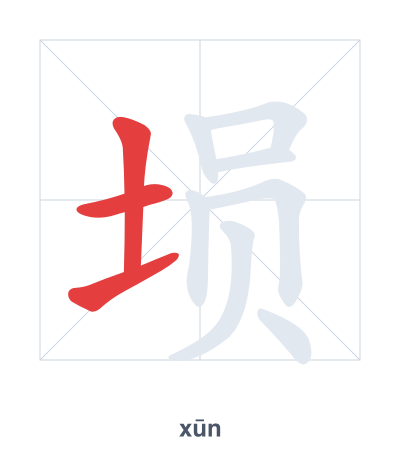
Open Hanzi Writer to see the animated stroke order and practice writing 埙 with real-time feedback.
The character 埙 (xūn) is written with 10 strokes. Follow the standard Chinese stroke order: top to bottom, left to right, outside before inside. The radical 土 is one of its key components.
Practice the correct stroke order with the Hanzi Writer app to see animated stroke-by-stroke guidance with real-time feedback.
埙 means Xun (an ancient wind instrument)..
The character 埙 combines the radical 土 (earth, clay) on the left, indicating the material, with 员 (yuán, round) on the right as a phonetic component, hinting at the instrument's rounded shape. An ancient wind instrument traditionally made of fired clay, the character visually reflects its earthy origin and circular form.
💡 Memory Tip: Picture a clay mound (土) with a round opening (员) like a mouth, waiting for you to blow into it and produce a haunting melody.
他在吹埙。
tā zài chuī xūn
He is playing the xun.
这是一个陶埙。
zhè shì yí gè táo xūn
This is a pottery xun (ancient wind instrument).
这首埙曲很好听。
zhè shǒu xūn qū hěn hǎo tīng
This Xun (vessel flute) music is very pleasant to hear.
Open Hanzi Writer to see the animated stroke order and practice writing 埙 with real-time feedback.
✨ Animated stroke order · Handwriting recognition · HSK-graded practice · Free to use
埙 is composed of the radical 土 (earth, clay) on the left, which hints that the instrument is made of clay. The right part is 员 (yuán, member) but here it provides the sound. Together, 埙 means an ancient clay wind instrument.