父 (fù) means "Father" in Chinese. It has 4 strokes with the radical 父, and is HSK Level 3.
Rated 2.4/5 in difficulty (moderate).
Harder than 9% of HSK Level 3 characters.
Appears in 3+ common words including 父亲 (fù qīn), 父母 (fù mǔ), 祖父 (zǔ fù).
Hanzi Writer's stroke validation shows learners typically need 5-8 attempts to write 父 with correct proportion and order.
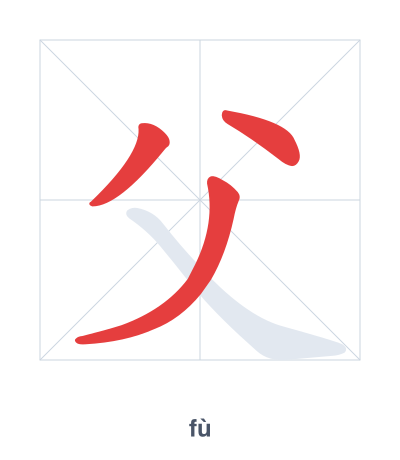
Open Hanzi Writer to see the animated stroke order and practice writing 父 with real-time feedback.
The character 父 (fù) is written with 4 strokes. Follow the standard Chinese stroke order: top to bottom, left to right, outside before inside. The radical 父 is one of its key components.
Practice the correct stroke order with the Hanzi Writer app to see animated stroke-by-stroke guidance with real-time feedback.
父 means Father.
As an HSK Level 3 character, 父 is an intermediate-level character.
The character 父 is a pictograph of a hand holding a stone axe or a stick, representing a man's role as a provider and protector in ancient times. The modern form still shows the cross-like top (the axe) and the bottom strokes (the hand).
💡 Memory Tip: Imagine a father figure standing with arms outstretched like the cross shape, saying 'I'll take care of everything.'
我的父亲是医生。
wǒ de fù qīn shì yī shēng
My father is a doctor.
父母都很爱我。
fù mǔ dōu hěn ài wǒ
Both of my parents love me very much.
祖父在公园散步。
zǔ fù zài gōng yuán sàn bù
Grandfather is taking a walk in the park.
Open Hanzi Writer to see the animated stroke order and practice writing 父 with real-time feedback.
✨ Animated stroke order · Handwriting recognition · HSK-graded practice · Free to use
The character 父 is a pictograph of a hand holding an axe, representing a father as the one who wields authority or works. It is both the radical and the whole character, with no separable components. Its simple 4-stroke form directly conveys the idea of a father figure.