祖 (zǔ) means "ancestor; grandfather" in Chinese. It has 9 strokes with the radical 礻, and is HSK Level 6.
Rated 4/5 in difficulty (challenging).
Harder than 52% of HSK Level 6 characters.
Appears in 3+ common words including 祖父 (zǔ fù), 祖国 (zǔ guó), 祖先 (zǔ xiān).
Due to its 9 strokes, Hanzi Writer's error detection shows 祖 requires focused practice — most learners need 10+ attempts for consistent accuracy.
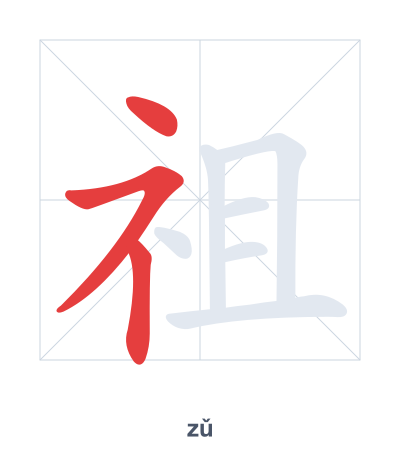
Open Hanzi Writer to see the animated stroke order and practice writing 祖 with real-time feedback.
The character 祖 (zǔ) is written with 9 strokes. Follow the standard Chinese stroke order: top to bottom, left to right, outside before inside. The radical 礻 is one of its key components.
Practice the correct stroke order with the Hanzi Writer app to see animated stroke-by-stroke guidance with real-time feedback.
祖 means ancestor; grandfather.
As an HSK Level 6 character, 祖 is an intermediate-level character.
The left component 礻 (示) depicts an altar or sacrificial offering, while the right component 且 originally showed a rectangular tablet or shrine for ancestors. Together, 祖 visually represents making offerings at an ancestral shrine, giving the meaning of ancestor or grandfather.
💡 Memory Tip: Picture an altar (礻) holding a rectangular tablet (且) that has a photo of your grandfather on it.
我的祖父很爱我。
wǒ de zǔ fù hěn ài wǒ
My grandfather loves me very much.
我热爱我的祖国。
wǒ rè ài wǒ de zǔ guó
I love my motherland.
我们要尊敬祖先。
wǒ men yào zūn jìng zǔ xiān
We should respect our ancestors.
Open Hanzi Writer to see the animated stroke order and practice writing 祖 with real-time feedback.
✨ Animated stroke order · Handwriting recognition · HSK-graded practice · Free to use
祖 consists of the radical 礻 (spirit/altar) on the left and 且 on the right. The right part 且 originally depicted an ancestor tablet, so together they mean 'ancestor' or 'grandfather'.