经 (jīng) means "To pass through, classics, or manage" in Chinese. It has 8 strokes with the radical 纟, and is HSK Level 2.
Rated 3.2/5 in difficulty (challenging).
Harder than 53% of HSK Level 2 characters.
Appears in 3+ common words including 经常 (jīng cháng), 经过 (jīng guò), 经理 (jīng lǐ).
Due to its 8 strokes, Hanzi Writer's error detection shows 经 requires focused practice — most learners need 10+ attempts for consistent accuracy.
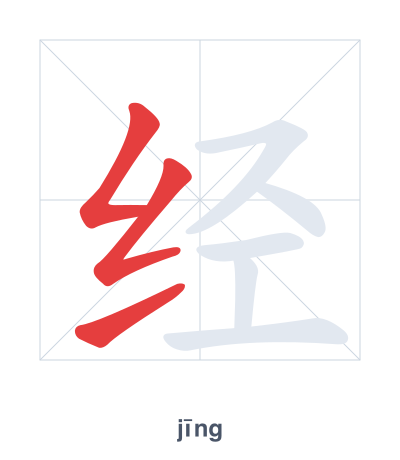
Open Hanzi Writer to see the animated stroke order and practice writing 经 with real-time feedback.
The character 经 (jīng) is written with 8 strokes. Follow the standard Chinese stroke order: top to bottom, left to right, outside before inside. The radical 纟 is one of its key components.
Practice the correct stroke order with the Hanzi Writer app to see animated stroke-by-stroke guidance with real-time feedback.
经 means To pass through, classics, or manage.
As an HSK Level 2 character, 经 is among the first characters beginners learn.
经 combines the silk radical 纟 with 巠, which originally depicted a warp thread in weaving—a straight line that passes through the fabric. This core idea of 'passing through' extended to mean canonical texts (the 'warp' of learning) and to manage or govern, like guiding a thread through its course. The character thus visually links silk threads with the concept of traversing or organizing.
💡 Memory Tip: Picture a silk thread (纟) threading through a needle that's sewing a straight line (巠) through a classic book—the thread passes through, manages the pages, and becomes part of the ancient text.
我经常去图书馆看书。
wǒ jīng cháng qù tú shū guǎn kàn shū
I often go to the library to read.
我每天经过这家书店。
wǒ měi tiān jīng guò zhè jiā shū diàn
I pass by this bookstore every day.
他是我们公司的经理。
tā shì wǒ men gōng sī de jīng lǐ
He is the manager of our company.
Open Hanzi Writer to see the animated stroke order and practice writing 经 with real-time feedback.
✨ Animated stroke order · Handwriting recognition · HSK-graded practice · Free to use
经 is composed of the radical 纟 (silk thread) on the left and 巠 on the right. The right side originally meant "vertical warp thread" in weaving, and together they suggest the idea of threads passing through fabric, which evolved into meanings like "to pass through" and "classics" (as in timeless threads).