蕈 (xùn) means "mushroom / fungus" in Chinese. It has 15 strokes with the radical 艹.
Rated 4.2/5 in difficulty (advanced).
Appears in 3+ common words including 蕈子 (xùn zi), 松蕈 (sōng xùn), 香蕈 (xiāng xùn).
Due to its 15 strokes, Hanzi Writer's error detection shows 蕈 requires focused practice — most learners need 10+ attempts for consistent accuracy.
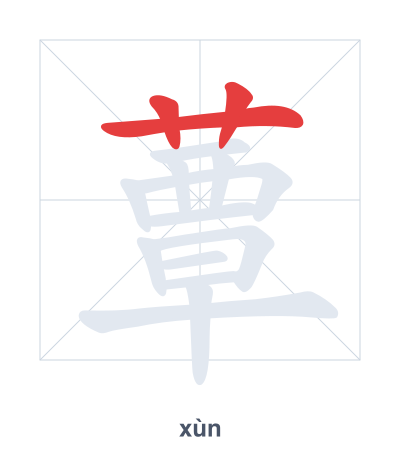
Open Hanzi Writer to see the animated stroke order and practice writing 蕈 with real-time feedback.
The character 蕈 (xùn) is written with 15 strokes. Follow the standard Chinese stroke order: top to bottom, left to right, outside before inside. The radical 艹 is one of its key components.
Practice the correct stroke order with the Hanzi Writer app to see animated stroke-by-stroke guidance with real-time feedback.
蕈 means mushroom / fungus.
蕈 is a phono-semantic compound combining the plant radical 艹 (grass/plant) with 覃 (xùn, also pronounced tán), which provides the sound and originally meant 'deep' or 'extend' — hinting at how mushrooms grow deep in the earth or spread across the ground. The character was created to specifically refer to fungi that sprout from the ground like plants but are distinct from ordinary herbs.
💡 Memory Tip: Picture a mushroom (艹) wearing a western hat (西) early in the morning (早) — that's 蕈, the fungi that pops up at dawn.
山上有许多蕈子。
shān shàng yǒu xǔ duō xùn zi
There are many mushrooms on the mountain.
松蕈的味道很鲜。
sōng xùn de wèi dào hěn xiān
Matsutake mushrooms taste very fresh.
妈妈买了些香蕈。
mā mā mǎi le xiē xiāng xùn
Mom bought some shiitake mushrooms.
Open Hanzi Writer to see the animated stroke order and practice writing 蕈 with real-time feedback.
✨ Animated stroke order · Handwriting recognition · HSK-graded practice · Free to use
The character 蕈 has the grass radical 艹 on top, showing it is a type of plant. The bottom part 覃 (xùn in this context) provides the pronunciation. Together, the structure indicates a plant-like organism, specifically a mushroom or fungus.