哺 (bǔ) means "To feed / To nurse" in Chinese. It has 10 strokes with the radical 口, and is HSK Level 7.
Rated 4.2/5 in difficulty (advanced).
Harder than 48% of HSK Level 7 characters.
Appears in 3+ common words including 哺乳 (bǔ rǔ), 哺育 (bǔ yù), 哺养 (bǔ yǎng).
Due to its 10 strokes, Hanzi Writer's error detection shows 哺 requires focused practice — most learners need 10+ attempts for consistent accuracy.
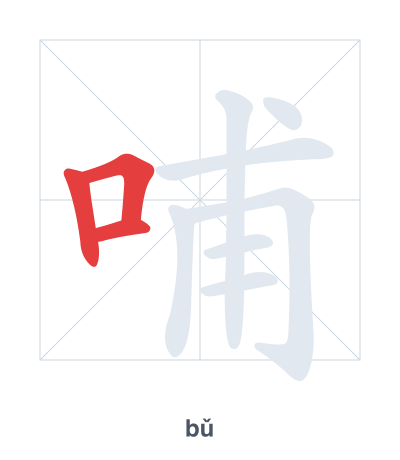
Open Hanzi Writer to see the animated stroke order and practice writing 哺 with real-time feedback.
The character 哺 (bǔ) is written with 10 strokes. Follow the standard Chinese stroke order: top to bottom, left to right, outside before inside. The radical 口 is one of its key components.
Practice the correct stroke order with the Hanzi Writer app to see animated stroke-by-stroke guidance with real-time feedback.
哺 means To feed / To nurse.
As an HSK Level 7 character, 哺 is an intermediate-level character.
The character 哺 combines the mouth radical 口, representing the act of eating or feeding, with 甫 (fǔ), which originally depicted a plant sprouting and carried the sense of 'nourishment' or 'spreading'. Together they convey the idea of using the mouth to provide nourishment, as in a mother feeding her infant.
💡 Memory Tip: Picture a mother bird using her mouth (口) to place a worm into her chick's open beak, while the right side 甫 resembles a tiny nest cradling the baby.
鲸鱼是哺乳动物。
jīng yú shì bǔ rǔ dòng wù
Whales are mammals.
父母哺育我们长大。
fù mǔ bǔ yù wǒ men zhǎng dà
Our parents nurtured and raised us.
她在哺养小猫。
tā zài bǔ yǎng xiǎo māo
She is nursing a kitten.
Open Hanzi Writer to see the animated stroke order and practice writing 哺 with real-time feedback.
✨ Animated stroke order · Handwriting recognition · HSK-graded practice · Free to use
哺 is made of the mouth radical 口 on the left and 甫 (fǔ, meaning "begin" or "father") on the right. The mouth radical suggests an action done with the mouth, like feeding, while 甫 provides pronunciation. Together they form the idea of nourishing or feeding someone by mouth.