育 (yù) means "to raise; to educate; to give birth" in Chinese. It has 8 strokes with the radical 月, and is HSK Level 2.
Rated 3.2/5 in difficulty (challenging).
Harder than 54% of HSK Level 2 characters.
Appears in 3+ common words including 教育 (jiào yù), 体育 (tǐ yù), 育儿 (yù ér).
Due to its 8 strokes, Hanzi Writer's error detection shows 育 requires focused practice — most learners need 10+ attempts for consistent accuracy.
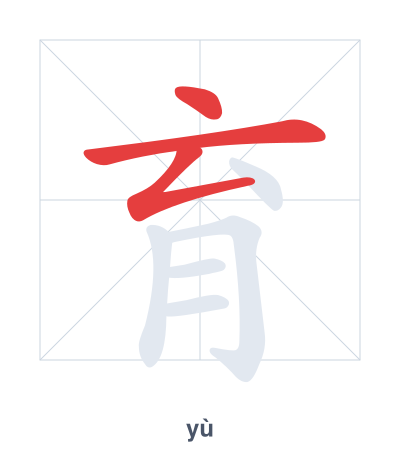
Open Hanzi Writer to see the animated stroke order and practice writing 育 with real-time feedback.
The character 育 (yù) is written with 8 strokes. Follow the standard Chinese stroke order: top to bottom, left to right, outside before inside. The radical 月 is one of its key components.
Practice the correct stroke order with the Hanzi Writer app to see animated stroke-by-stroke guidance with real-time feedback.
育 means to raise; to educate; to give birth.
As an HSK Level 2 character, 育 is among the first characters beginners learn.
The ancient form of 育 depicted a woman giving birth, with a baby (子) and flowing fluid. The modern structure combines 月 (flesh/body) and 充 (to fill), symbolizing nourishing the body to raise or educate a child.
💡 Memory Tip: Picture a head (亠) on a fleshy body (月) with a leg (乚) kicking out—a newborn being raised and educated.
良好的教育很重要。
liáng hǎo de jiào yù hěn zhòng yào
A good education is very important.
我每天都上体育课。
wǒ měi tiān dōu shàng tǐ yù kè
I have PE class every day.
育儿是一门学问。
yù ér shì yī mén xué wèn
Parenting is a field of study.
Open Hanzi Writer to see the animated stroke order and practice writing 育 with real-time feedback.
✨ Animated stroke order · Handwriting recognition · HSK-graded practice · Free to use
育 is made of three parts: the top 亠 (like a head), the middle 月 (flesh or body), and the bottom 冫 (ice or fluid). This structure symbolizes a baby being born or nurtured, connecting to its meanings of giving birth and raising.