冰 (bīng) means "Ice" in Chinese. It has 6 strokes with the radical 冫, and is HSK Level 4.
Rated 2.9/5 in difficulty (moderate).
Harder than 9% of HSK Level 4 characters.
Appears in 3+ common words including 冰水 (bīng shuǐ), 冰箱 (bīng xiāng), 冰块 (bīng kuài).
Hanzi Writer's stroke validation shows learners typically need 5-8 attempts to write 冰 with correct proportion and order.
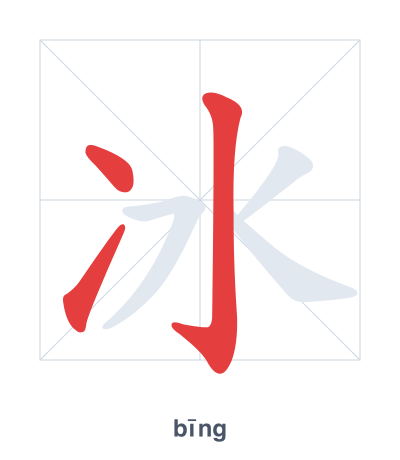
Open Hanzi Writer to see the animated stroke order and practice writing 冰 with real-time feedback.
The character 冰 (bīng) is written with 6 strokes. Follow the standard Chinese stroke order: top to bottom, left to right, outside before inside. The radical 冫 is one of its key components.
Practice the correct stroke order with the Hanzi Writer app to see animated stroke-by-stroke guidance with real-time feedback.
冰 means Ice.
As an HSK Level 4 character, 冰 is an intermediate-level character.
冰 combines the ice radical 冫 (originally a pictograph of ice cracks) with 水 (water), visually showing water transformed into ice. In its ancient form, 冫 alone represented ice, but the modern character adds the water component for clarity.
💡 Memory Tip: Imagine two icicles (冫) hanging from a frozen water surface (the right side 水) that has turned into solid ice.
我想喝冰水。
wǒ xiǎng hē bīng shuǐ
I want to drink ice water.
冰箱里有牛奶。
bīng xiāng lǐ yǒu niú nǎi
There is milk in the fridge.
请加一点冰块。
qǐng jiā yì diǎn bīng kuài
Please add some ice cubes.
Open Hanzi Writer to see the animated stroke order and practice writing 冰 with real-time feedback.
✨ Animated stroke order · Handwriting recognition · HSK-graded practice · Free to use
冰 is made of the radical 冫, which means ice or cold, and the component 水, which means water. Together, they show that ice is frozen water. This structure directly represents the meaning of ice.