冻 (dòng) means "to freeze; to feel cold" in Chinese. It has 7 strokes with the radical 冫, and is HSK Level 5.
Rated 3.2/5 in difficulty (challenging).
Harder than 12% of HSK Level 5 characters.
Appears in 3+ common words including 冷冻 (lěng dòng), 冻结 (dòng jié), 冰冻 (bīng dòng).
Due to its 7 strokes, Hanzi Writer's error detection shows 冻 requires focused practice — most learners need 10+ attempts for consistent accuracy.
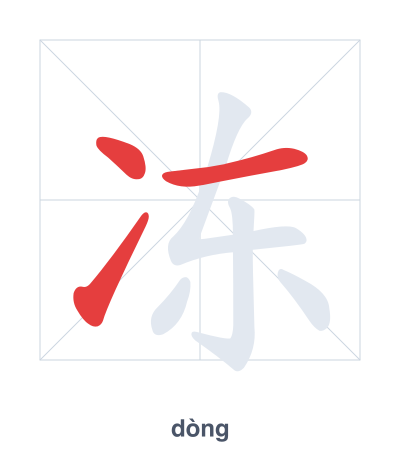
Open Hanzi Writer to see the animated stroke order and practice writing 冻 with real-time feedback.
The character 冻 (dòng) is written with 7 strokes. Follow the standard Chinese stroke order: top to bottom, left to right, outside before inside. The radical 冫 is one of its key components.
Practice the correct stroke order with the Hanzi Writer app to see animated stroke-by-stroke guidance with real-time feedback.
冻 means to freeze; to feel cold.
As an HSK Level 5 character, 冻 is an intermediate-level character.
冻 combines the ice radical 冫 with 东 (dōng, 'east') as a phonetic component. The ancient form of 冫 depicts two ice crystals, so the character literally means 'ice in the east' — cold enough to freeze.
💡 Memory Tip: Imagine the eastern wind blowing so fiercely that it freezes the river (冫) solid, turning everything into a block of ice.
肉放在冷冻室里。
ròu fàng zài lěng dòng shì lǐ
The meat is in the freezer.
湖水已经冻结了。
hú shuǐ yǐ jīng dòng jié le
The lake water has already frozen.
路上有很多冰冻。
lù shàng yǒu hěn duō bīng dòng
There is a lot of ice on the road.
Open Hanzi Writer to see the animated stroke order and practice writing 冻 with real-time feedback.
✨ Animated stroke order · Handwriting recognition · HSK-graded practice · Free to use
冻 combines the ice radical 冫 on the left with 东 (dōng, east) on the right. The ice radical indicates cold or freezing, while 东 provides the sound. Together they form a character meaning "to freeze" or "to feel cold."