况 (kuàng) means "situation; condition; moreover" in Chinese. It has 7 strokes with the radical 冫, and is HSK Level 3.
Rated 3.2/5 in difficulty (challenging).
Harder than 27% of HSK Level 3 characters.
Appears in 3+ common words including 情况 (qíng kuàng), 何况 (hé kuàng), 近况 (jìn kuàng).
Due to its 7 strokes, Hanzi Writer's error detection shows 况 requires focused practice — most learners need 10+ attempts for consistent accuracy.
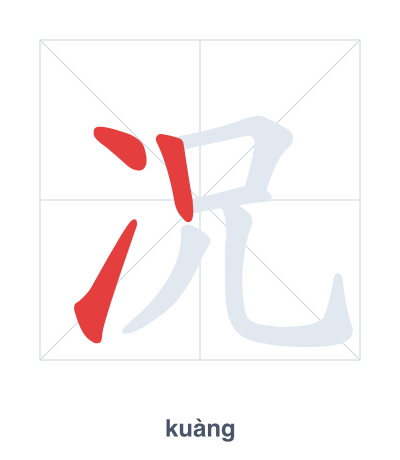
Open Hanzi Writer to see the animated stroke order and practice writing 况 with real-time feedback.
The character 况 (kuàng) is written with 7 strokes. Follow the standard Chinese stroke order: top to bottom, left to right, outside before inside. The radical 冫 is one of its key components.
Practice the correct stroke order with the Hanzi Writer app to see animated stroke-by-stroke guidance with real-time feedback.
况 means situation; condition; moreover.
As an HSK Level 3 character, 况 is an intermediate-level character.
况 combines the radical 冫 (ice) with 兄 (elder brother) as a phonetic component. Originally it referred to a cold or icy condition, from which the meanings 'situation' and 'moreover' developed.
💡 Memory Tip: Picture an older brother (兄) shivering on an ice block (冫), carefully evaluating the harsh situation before deciding to move.
情况怎么样?
qíng kuàng zěn me yàng
How is the situation?
他不去,何况我呢?
tā bù qù hé kuàng wǒ ne
He isn't going, let alone me.
告诉我你的近况。
gào sù wǒ nǐ de jìn kuàng
Tell me how you've been lately.
Open Hanzi Writer to see the animated stroke order and practice writing 况 with real-time feedback.
✨ Animated stroke order · Handwriting recognition · HSK-graded practice · Free to use
The character 况 has two parts: the left component 冫 (ice radical) and the right component 兄 (elder brother). The radical 冫 is a simplified form of 冰 (ice), but in 况 it does not directly contribute to the meaning; instead, 兄 provides the pronunciation kuàng. Together they form a character that means 'situation' or 'condition,' though the link between the components and the meaning is not direct.