绷 (bēng/běng) means "to stretch tight; bandage" in Chinese. It has 11 strokes with the radical 纟, and is HSK Level 7.
Rated 4.2/5 in difficulty (advanced).
Harder than 80% of HSK Level 7 characters.
Appears in 4+ common words including 绷带 (bēng dài), 绷紧 (bēng jǐn), 绷直 (bēng zhí).
Due to its 11 strokes, Hanzi Writer's error detection shows 绷 requires focused practice — most learners need 10+ attempts for consistent accuracy.
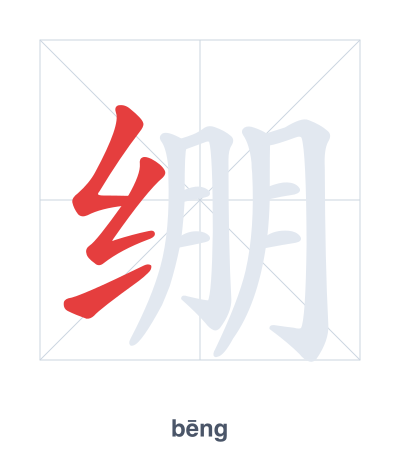
Open Hanzi Writer to see the animated stroke order and practice writing 绷 with real-time feedback.
The character 绷 (bēng/běng) is written with 11 strokes. Follow the standard Chinese stroke order: top to bottom, left to right, outside before inside. The radical 纟 is one of its key components.
Practice the correct stroke order with the Hanzi Writer app to see animated stroke-by-stroke guidance with real-time feedback.
绷 means to stretch tight; bandage.
This is a polyphonic character with readings: bēng, běng.
As an HSK Level 7 character, 绷 is an intermediate-level character.
The character 绷 combines the silk radical 纟, representing thread or fabric, with 崩, which provides the sound bēng and suggests the idea of 'bursting' or 'stretching to the limit.' Together, they evoke tightening a cloth bandage so firmly it feels near breaking.
💡 Memory Tip: Imagine a silk bandage (纟) stretched so taut over a mountain (崩) that it snaps and collapses—the tension is unbearable.
医生给我用了绷带。
yī shēng gěi wǒ yòng le bēng dài
The doctor applied a bandage to me.
绳子拉得很绷紧。
shéng zi lā dé hěn bēng jǐn
The rope is pulled very tight.
请把你的腿绷直。
qǐng bǎ nǐ de tuǐ bēng zhí
Please keep your legs straight.
他整天绷着脸,好像谁欠他钱似的。
tā zhěng tiān běng zhe liǎn, hǎo xiàng shéi qiàn tā qián shì de
He keeps a straight face all day, as if someone owes him money.
Open Hanzi Writer to see the animated stroke order and practice writing 绷 with real-time feedback.
✨ Animated stroke order · Handwriting recognition · HSK-graded practice · Free to use
The left side is 纟 (silk radical), which relates to thread or cloth. The right side is 崩 (bēng, meaning collapse), which gives the sound and suggests something stretched to the point of snapping. Together, they create the idea of pulling cloth tight, like a bandage.