绑 (bǎng) means "To tie or bind." in Chinese. It has 9 strokes with the radical 纟, and is HSK Level 7.
Rated 4/5 in difficulty (challenging).
Harder than 44% of HSK Level 7 characters.
Appears in 3+ common words including 绑架 (bǎng jià), 捆绑 (kǔn bǎng), 绑带 (bǎng dài).
Due to its 9 strokes, Hanzi Writer's error detection shows 绑 requires focused practice — most learners need 10+ attempts for consistent accuracy.
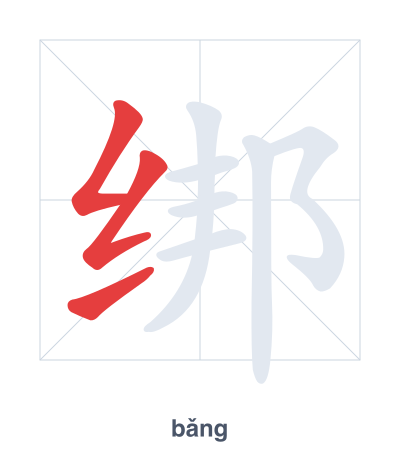
Open Hanzi Writer to see the animated stroke order and practice writing 绑 with real-time feedback.
The character 绑 (bǎng) is written with 9 strokes. Follow the standard Chinese stroke order: top to bottom, left to right, outside before inside. The radical 纟 is one of its key components.
Practice the correct stroke order with the Hanzi Writer app to see animated stroke-by-stroke guidance with real-time feedback.
绑 means To tie or bind..
As an HSK Level 7 character, 绑 is an intermediate-level character.
绑 is a phono-semantic compound. The radical 纟 (silk thread) indicates that the character relates to tying or binding with string or rope. The other component, 邦 (bāng, meaning 'state' or 'country'), provides the pronunciation hint.
💡 Memory Tip: Imagine binding a giant silk ribbon around a whole country (邦) to keep it tied together.
这是一个绑架案。
zhè shì yí gè bǎng jià àn
This is a kidnapping case.
请把这些书捆绑好。
qǐng bǎ zhè xiē shū kǔn bǎng hǎo
Please tie these books together.
他的腿上缠着绑带。
tā de tuǐ shàng chán zhe bǎng dài
His leg is wrapped in bandages.
Open Hanzi Writer to see the animated stroke order and practice writing 绑 with real-time feedback.
✨ Animated stroke order · Handwriting recognition · HSK-graded practice · Free to use
The character 绑 combines the radical 纟 (silk) on the left, which represents threads or ropes used for binding, with the phonetic component 邦 (bāng) on the right. Together, the silk radical indicates the action of tying or binding, while 邦 provides the pronunciation. So the structure hints at "binding with a rope" and tells you how to say it.