祀 (sì) means "To offer sacrifices / To worship" in Chinese. It has 7 strokes with the radical 礻, and is HSK Level 7.
Rated 3.5/5 in difficulty (challenging).
Harder than 20% of HSK Level 7 characters.
Appears in 3+ common words including 祭祀 (jì sì), 祀堂 (sì táng), 奉祀 (fèng sì).
Due to its 7 strokes, Hanzi Writer's error detection shows 祀 requires focused practice — most learners need 10+ attempts for consistent accuracy.
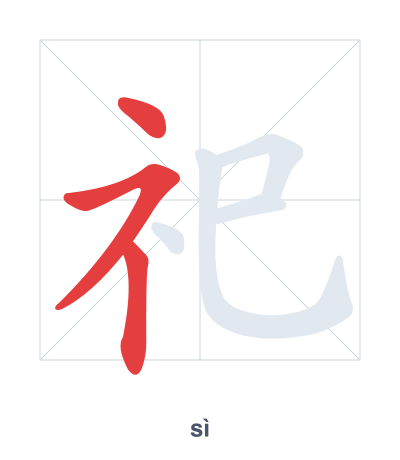
Open Hanzi Writer to see the animated stroke order and practice writing 祀 with real-time feedback.
The character 祀 (sì) is written with 7 strokes. Follow the standard Chinese stroke order: top to bottom, left to right, outside before inside. The radical 礻 is one of its key components.
Practice the correct stroke order with the Hanzi Writer app to see animated stroke-by-stroke guidance with real-time feedback.
祀 means To offer sacrifices / To worship.
As an HSK Level 7 character, 祀 is an intermediate-level character.
The character 祀 combines the radical 礻 (a variant of 示, meaning altar or spirit) with 巳 (sì), which serves as a phonetic component. Together they represent the act of offering sacrifices to ancestral spirits or deities at an altar.
💡 Memory Tip: Picture a coiled snake (巳) placed on an altar (礻) as a sacred offering during a worship ritual.
他们在祭祀祖先。
tā men zài jì sì zǔ xiān
They are offering sacrifices to their ancestors.
这是一个古老的祀堂。
zhè shì yí gè gǔ lǎo de sì táng
This is an ancient ancestral hall.
这里奉祀着神灵。
zhè lǐ fèng sì zhe shén líng
Deities are worshipped here.
Open Hanzi Writer to see the animated stroke order and practice writing 祀 with real-time feedback.
✨ Animated stroke order · Handwriting recognition · HSK-graded practice · Free to use
The left radical 礻 is a variant of 示, meaning spirit or altar, which directly connects to worship. The right part 巳 is a phonetic component that gives the pronunciation sì, and its shape can be seen as a kneeling figure. Together, the character depicts a person making an offering at an altar.