祎 (yī) means "beautiful; fine (often used in names)" in Chinese. It has 8 strokes with the radical 礻.
Rated 3.7/5 in difficulty (challenging).
Appears in 3+ common words including 祎隋 (yī suí), 祎博 (yī bó), 姓祎 (xìng yī).
Due to its 8 strokes, Hanzi Writer's error detection shows 祎 requires focused practice — most learners need 10+ attempts for consistent accuracy.
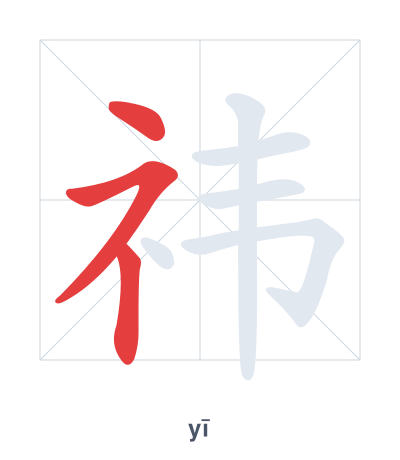
Open Hanzi Writer to see the animated stroke order and practice writing 祎 with real-time feedback.
The character 祎 (yī) is written with 8 strokes. Follow the standard Chinese stroke order: top to bottom, left to right, outside before inside. The radical 礻 is one of its key components.
Practice the correct stroke order with the Hanzi Writer app to see animated stroke-by-stroke guidance with real-time feedback.
祎 means beautiful; fine (often used in names).
祎 is a compound character where the radical 礻 (示, meaning 'spirit' or 'altar') suggests divine blessing or auspiciousness, while 韦 (wéi, originally a pictograph of a leather belt) provides phonetic guidance. Together, they convey the sense of something beautiful or fine, often used in names to wish good fortune and elegance.
💡 Memory Tip: Picture a spirit (礻) blessing a beautiful leather belt (韦) to make it fine and elegant.
他的文笔很祎隋。
tā de wén bǐ hěn yī suí
His writing style is beautiful and smooth.
这个词很祎博。
zhè ge cí hěn yī bó
This word is very profound and extensive.
他的朋友姓祎。
tā de péng yǒu xìng yī
His friend's surname is Yi.
Open Hanzi Writer to see the animated stroke order and practice writing 祎 with real-time feedback.
✨ Animated stroke order · Handwriting recognition · HSK-graded practice · Free to use
祎 is composed of the radical 礻 (meaning spirit or altar) on the left and 韦 (a phonetic component derived from 韋) on the right. The radical hints at a connection to spirituality or ritual, but 祎 is not used in religious contexts — instead, it carries the meaning of 'beautiful' or 'fine', especially in names. The phonetic part 韦 does not directly contribute to the meaning; the character as a whole is a traditional name character.