祉 (zhǐ) means "blessing; happiness" in Chinese. It has 8 strokes with the radical 礻.
Rated 3.7/5 in difficulty (challenging).
Appears in 3+ common words including 福祉 (fú zhǐ), 康祉 (kāng zhǐ), 祉猷 (zhǐ yóu).
Due to its 8 strokes, Hanzi Writer's error detection shows 祉 requires focused practice — most learners need 10+ attempts for consistent accuracy.
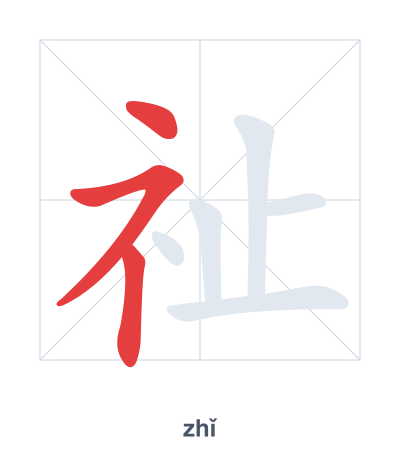
Open Hanzi Writer to see the animated stroke order and practice writing 祉 with real-time feedback.
The character 祉 (zhǐ) is written with 8 strokes. Follow the standard Chinese stroke order: top to bottom, left to right, outside before inside. The radical 礻 is one of its key components.
Practice the correct stroke order with the Hanzi Writer app to see animated stroke-by-stroke guidance with real-time feedback.
祉 means blessing; happiness.
祉 is a phono-semantic compound combining the radical 礻 (spirit, divine) with 止 (stop) as a phonetic component. Originally it referred to blessings or happiness bestowed by spirits or deities.
💡 Memory Tip: Imagine a spirit (礻) telling you to stop (止) because a blessing is about to be showered upon you.
提高人民的福祉。
tí gāo rén mín de fú zhǐ
Improve the people's well-being.
祝您身体康祉。
zhù nín shēn tǐ kāng zhǐ
Wishing you good health and well-being.
祝你祉猷并茂。
zhù nǐ zhǐ yóu bìng mào
Wish you both happiness and success.
Open Hanzi Writer to see the animated stroke order and practice writing 祉 with real-time feedback.
✨ Animated stroke order · Handwriting recognition · HSK-graded practice · Free to use
The left component 礻 (shì) is a radical meaning 'spirit' or 'altar,' indicating blessings from heaven. The right part 止 (zhǐ) is a phonetic hint for pronunciation, and together they suggest happiness granted by spiritual forces.