祇 (qí) means "Earth god / Only" in Chinese. It has 8 strokes with the radical 礻.
Rated 3.7/5 in difficulty (challenging).
Appears in 3+ common words including 神祇 (shén qí), 地祇 (dì qí), 祇灵 (qí líng).
Due to its 8 strokes, Hanzi Writer's error detection shows 祇 requires focused practice — most learners need 10+ attempts for consistent accuracy.
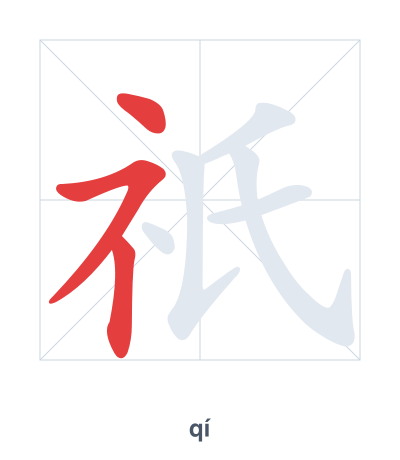
Open Hanzi Writer to see the animated stroke order and practice writing 祇 with real-time feedback.
The character 祇 (qí) is written with 8 strokes. Follow the standard Chinese stroke order: top to bottom, left to right, outside before inside. The radical 礻 is one of its key components.
Practice the correct stroke order with the Hanzi Writer app to see animated stroke-by-stroke guidance with real-time feedback.
祇 means Earth god / Only.
祇 combines the radical 礻 (spirit/altar) with 氏, which originally depicted a foundation or base, together representing a spirit of the ground—the earth god. The meaning 'only' later emerged as a phonetic borrowing, unrelated to the visual structure.
💡 Memory Tip: Imagine a spirit altar (礻) where a clan (氏) prays to the one and only earth god (祇).
人们敬畏神祇。
rén men jìng wèi shén qí
People revere the gods.
古代人祭祀地祇。
gǔ dài rén jì sì dì qí
Ancient people offered sacrifices to the earth gods.
祈求祇灵保佑。
qí qiú qí líng bǎo yòu
Pray for the protection of the spirits.
Open Hanzi Writer to see the animated stroke order and practice writing 祇 with real-time feedback.
✨ Animated stroke order · Handwriting recognition · HSK-graded practice · Free to use
The character 祇 has the left radical 礻, which is a form of 示 meaning "spirit" or "altar." The right part is 氏, which originally meant "clan" or "foundation." Together, they suggest a spirit connected to the earth, matching the meaning "earth god."