祓 (fú) means "to cleanse; to perform an exorcism" in Chinese. It has 9 strokes with the radical 礻.
Rated 4/5 in difficulty (challenging).
Appears in 3+ common words including 祓除 (fú chú), 祓禊 (fú xì), 祓饰 (fú shì).
Due to its 9 strokes, Hanzi Writer's error detection shows 祓 requires focused practice — most learners need 10+ attempts for consistent accuracy.
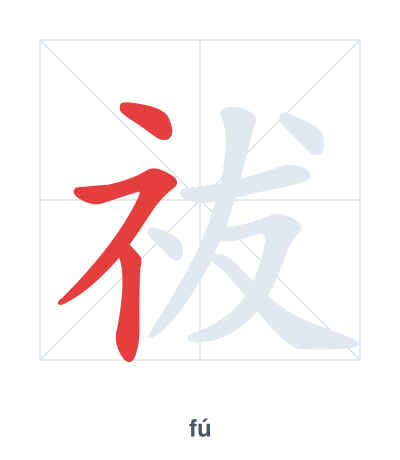
Open Hanzi Writer to see the animated stroke order and practice writing 祓 with real-time feedback.
The character 祓 (fú) is written with 9 strokes. Follow the standard Chinese stroke order: top to bottom, left to right, outside before inside. The radical 礻 is one of its key components.
Practice the correct stroke order with the Hanzi Writer app to see animated stroke-by-stroke guidance with real-time feedback.
祓 means to cleanse; to perform an exorcism.
祓 is a phono-semantic compound: the radical 礻 (示) indicates it relates to spirits or rituals, while the right component 犮 (originally a variant of 犬 'dog' with an extra stroke) provides the sound and also suggests the act of pulling out or driving away evil—like a dog used in ancient exorcisms to chase away unclean influences.
💡 Memory Tip: Picture a shaman (礻) commanding a fierce dog (犮) to leap and bite away all impurities during a cleansing ritual.
祓除灾祸是旧习俗。
fú chú zāi huò shì jiù xí sú
Dispelling disasters is an old custom.
祓禊是古代的仪式。
fú xì shì gǔ dài de yí shì
Ritual purification is an ancient ceremony.
这里的祓饰很精美。
zhè lǐ de fú shì hěn jīng měi
The purification ornaments here are very exquisite.
Open Hanzi Writer to see the animated stroke order and practice writing 祓 with real-time feedback.
✨ Animated stroke order · Handwriting recognition · HSK-graded practice · Free to use
祓 is made of the radical 礻 (spirit or altar) on the left and the component 犮 (pronounced bá) on the right. The radical ties the character to religious or spiritual actions, while 犮 serves as a phonetic hint. Together they suggest a ritual cleansing or exorcism performed in a spiritual context.