骤 (zhòu) means "sudden" in Chinese. It has 17 strokes with the radical 马, and is HSK Level 7.
Rated 4.2/5 in difficulty (advanced).
Harder than 99% of HSK Level 7 characters.
Appears in 3+ common words including 步骤 (bù zhòu), 骤然 (zhòu rán), 骤降 (zhòu jiàng).
Due to its 17 strokes, Hanzi Writer's error detection shows 骤 requires focused practice — most learners need 10+ attempts for consistent accuracy.
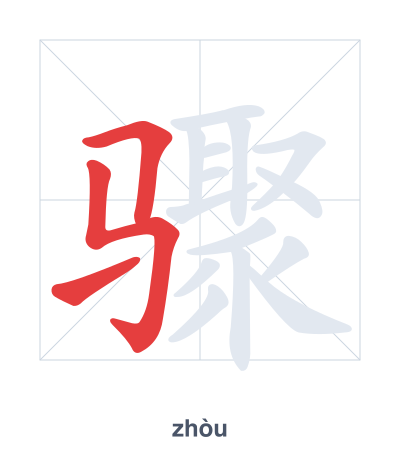
Open Hanzi Writer to see the animated stroke order and practice writing 骤 with real-time feedback.
The character 骤 (zhòu) is written with 17 strokes. Follow the standard Chinese stroke order: top to bottom, left to right, outside before inside. The radical 马 is one of its key components.
Practice the correct stroke order with the Hanzi Writer app to see animated stroke-by-stroke guidance with real-time feedback.
骤 means sudden.
As an HSK Level 7 character, 骤 is an intermediate-level character.
骤 combines the radical 马 (horse) with 聚 (gather/assemble). The original meaning was a horse galloping at full speed, implying a sudden, swift movement. The right component 聚, composed of 取 (take) and 众 (crowd), visually suggests a horse bursting forward with gathered force, intensifying the sense of abruptness.
💡 Memory Tip: Picture a horse (马) suddenly bolting into a crowded gathering (聚), startling everyone with its abrupt, fast charge.
请按照步骤操作。
qǐng àn zhào bù zhòu cāo zuò
Please follow the steps to operate.
天气骤然变冷了。
tiān qì zhòu rán biàn lěng le
The weather suddenly turned cold.
气温骤降了十度。
qì wēn zhòu jiàng le shí dù
The temperature dropped suddenly by ten degrees.
Open Hanzi Writer to see the animated stroke order and practice writing 骤 with real-time feedback.
✨ Animated stroke order · Handwriting recognition · HSK-graded practice · Free to use
The character 骤 combines the radical 马 (horse) on the left with the phonetic component 聚 (jù, meaning "gather") on the right. Horses can suddenly start moving fast or gather speed, linking the horse radical to the idea of a sudden action. The right part provides the pronunciation hint zhòu, as 聚 is pronounced jù but similar in sound.