骥 (jì) means "thoroughbred horse" in Chinese. It has 19 strokes with the radical 马.
Rated 4.2/5 in difficulty (advanced).
Appears in 3+ common words including 骥尾 (jì wěi), 骥足 (jì zú), 老骥伏枥 (lǎo jì fú lì).
Due to its 19 strokes, Hanzi Writer's error detection shows 骥 requires focused practice — most learners need 10+ attempts for consistent accuracy.
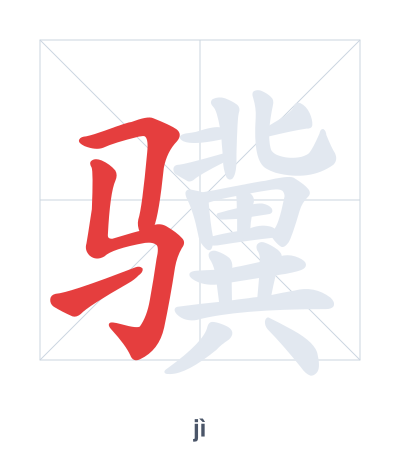
Open Hanzi Writer to see the animated stroke order and practice writing 骥 with real-time feedback.
The character 骥 (jì) is written with 19 strokes. Follow the standard Chinese stroke order: top to bottom, left to right, outside before inside. The radical 马 is one of its key components.
Practice the correct stroke order with the Hanzi Writer app to see animated stroke-by-stroke guidance with real-time feedback.
骥 means thoroughbred horse.
This character is a phono-semantic compound: the radical 马 (horse) indicates the meaning of a fine horse, while 冀 (jì) provides the pronunciation and also hints at the horse's aspirational nature, as 冀 means 'to hope' or 'to aspire,' reflecting the thoroughbred's noble speed and lineage.
💡 Memory Tip: Picture a thoroughbred horse (马) racing north (北) through fields (田) with great hope (冀) to become a champion.
他希望能附骥尾。
tā xī wàng néng fù jì wěi
He hopes to follow in the footsteps of a great person.
他在工作中展其骥足。
tā zài gōng zuò zhōng zhǎn qí jì zú
He shows his great talent in his work.
他真是老骥伏枥。
tā zhēn shì lǎo jì fú lì
He is like an old warhorse with great ambitions.
Open Hanzi Writer to see the animated stroke order and practice writing 骥 with real-time feedback.
✨ Animated stroke order · Handwriting recognition · HSK-graded practice · Free to use
The character 骥 is made of the radical 马 (horse) on the left, indicating it is a type of horse. The right side is 冀 (jì), which provides the sound and also suggests the idea of high expectations—so a thoroughbred horse is one that is hoped to be excellent.