骣 (chǎn) means "to ride bareback" in Chinese. It has 15 strokes with the radical 马.
Rated 4.2/5 in difficulty (advanced).
Appears in 3+ common words including 骣骑 (chǎn qí), 骣马 (chǎn mǎ), 骣骑而行 (chǎn qí ér xíng).
Due to its 15 strokes, Hanzi Writer's error detection shows 骣 requires focused practice — most learners need 10+ attempts for consistent accuracy.
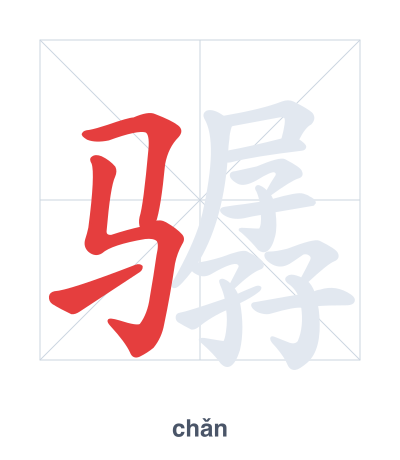
Open Hanzi Writer to see the animated stroke order and practice writing 骣 with real-time feedback.
The character 骣 (chǎn) is written with 15 strokes. Follow the standard Chinese stroke order: top to bottom, left to right, outside before inside. The radical 马 is one of its key components.
Practice the correct stroke order with the Hanzi Writer app to see animated stroke-by-stroke guidance with real-time feedback.
骣 means to ride bareback.
骣 is a phono-semantic compound, with 马 (horse) as the semantic component indicating riding, and 孱 (chán, meaning 'weak' or 'frail') as the phonetic component. The 'frail' notion suggests the lack of a saddle, making the ride bareback and less secure.
💡 Memory Tip: Picture a horse (马) and a weak (孱) rider clinging desperately to its bare back without a saddle.
他喜欢在河边骣骑。
tā xǐ huān zài hé biān chǎn qí
He likes riding bareback by the river.
他骑着一匹骣马。
tā qí zhe yì pǐ chǎn mǎ
He was riding a bareback horse.
他骣骑而行去远方。
tā chǎn qí ér xíng qù yuǎn fāng
He rode bareback to a distant place.
Open Hanzi Writer to see the animated stroke order and practice writing 骣 with real-time feedback.
✨ Animated stroke order · Handwriting recognition · HSK-graded practice · Free to use
The character 骣 is made of the radical 马 (horse) on the left and the component 免 (miǎn, meaning 'without' or 'to avoid') on the right. This combination suggests riding a horse without a saddle, which is the meaning of 'to ride bareback'.