痔 (zhì) means "hemorrhoids" in Chinese. It has 11 strokes with the radical 疒.
Rated 4.2/5 in difficulty (advanced).
Appears in 3+ common words including 痔疮 (zhì chuāng), 内痔 (nèi zhì), 外痔 (wài zhì).
Due to its 11 strokes, Hanzi Writer's error detection shows 痔 requires focused practice — most learners need 10+ attempts for consistent accuracy.
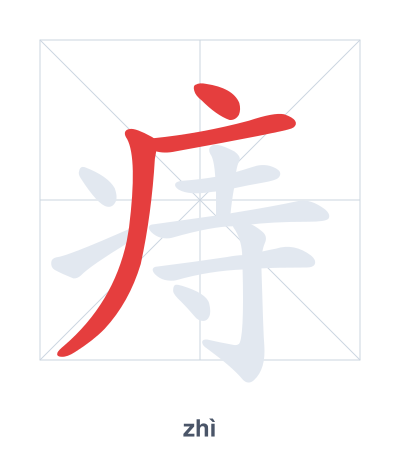
Open Hanzi Writer to see the animated stroke order and practice writing 痔 with real-time feedback.
The character 痔 (zhì) is written with 11 strokes. Follow the standard Chinese stroke order: top to bottom, left to right, outside before inside. The radical 疒 is one of its key components.
Practice the correct stroke order with the Hanzi Writer app to see animated stroke-by-stroke guidance with real-time feedback.
痔 means hemorrhoids.
This character combines the illness radical 疒 with the phonetic component 寺 (temple, pronounced sì but serving as a sound hint for zhì). Together they signify a disease condition associated with swollen veins, i.e., hemorrhoids.
💡 Memory Tip: Picture a sick person on a bed (疒) with a small swollen mound (like the earth 土) the size of an inch (寸) — that's your hemorrhoid.
他最近得了痔疮。
tā zuì jìn dé le zhì chuāng
He recently got hemorrhoids.
医生说这是内痔。
yī shēng shuō zhè shì nèi zhì
The doctor said these are internal hemorrhoids.
外痔需要做手术吗?
wài zhì xū yào zuò shǒu shù ma
Do external hemorrhoids require surgery?
Open Hanzi Writer to see the animated stroke order and practice writing 痔 with real-time feedback.
✨ Animated stroke order · Handwriting recognition · HSK-graded practice · Free to use
The character 痔 is built with the radical 疒 (illness) on the outside and the component 寺 (temple) on the inside. The 疒 radical shows this character relates to a disease, while 寺 provides the pronunciation zhì. Together, 疒 and 寺 form a word for the medical condition hemorrhoids.