疤 (bā) means "scar" in Chinese. It has 9 strokes with the radical 疒.
Rated 4/5 in difficulty (challenging).
Appears in 3+ common words including 疤痕 (bā hén), 伤疤 (shāng bā), 结疤 (jié bā).
Due to its 9 strokes, Hanzi Writer's error detection shows 疤 requires focused practice — most learners need 10+ attempts for consistent accuracy.
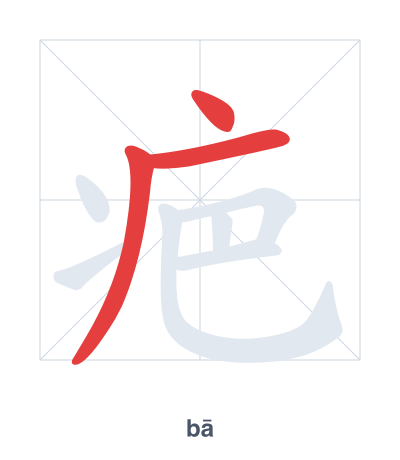
Open Hanzi Writer to see the animated stroke order and practice writing 疤 with real-time feedback.
The character 疤 (bā) is written with 9 strokes. Follow the standard Chinese stroke order: top to bottom, left to right, outside before inside. The radical 疒 is one of its key components.
Practice the correct stroke order with the Hanzi Writer app to see animated stroke-by-stroke guidance with real-time feedback.
疤 means scar.
疤 is a phono-semantic compound combining the radical 疒 (illness or injury) with 巴 (bā) as a phonetic component. The 疒 radical indicates that the character relates to a physical ailment or mark on the skin, while 巴 also conveys the idea of something that clings or sticks, like a scar that persists on the body.
💡 Memory Tip: Picture a sick person (疒) with a snake (巴) crawling on their skin, leaving a permanent scar.
他脸上有一道疤痕。
tā liǎn shàng yǒu yī dào bā hén
He has a scar on his face.
别揭别人的伤疤。
bié jiē bié rén de shāng bā
Don't reopen old wounds.
伤口已经结疤了。
shāng kǒu yǐ jīng jié bā le
The wound has already scarred over.
Open Hanzi Writer to see the animated stroke order and practice writing 疤 with real-time feedback.
✨ Animated stroke order · Handwriting recognition · HSK-graded practice · Free to use
疤 is made of the radical 疒 (illness or disease) on the left and the phonetic component 巴 (bā) on the right. The 疒 radical suggests a skin mark or wound, while 巴 gives the sound and hints at a "bar" or line across the skin. Together they mean a scar left after a wound heals.