疮 (chuāng) means "sore" in Chinese. It has 9 strokes with the radical 疒.
Rated 4/5 in difficulty (challenging).
Appears in 3+ common words including 冻疮 (dòng chuāng), 痔疮 (zhì chuāng), 疮疤 (chuāng bā).
Due to its 9 strokes, Hanzi Writer's error detection shows 疮 requires focused practice — most learners need 10+ attempts for consistent accuracy.
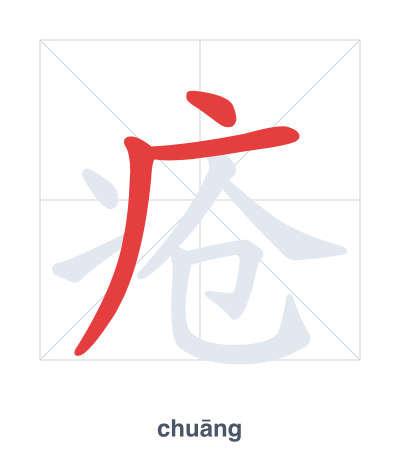
Open Hanzi Writer to see the animated stroke order and practice writing 疮 with real-time feedback.
The character 疮 (chuāng) is written with 9 strokes. Follow the standard Chinese stroke order: top to bottom, left to right, outside before inside. The radical 疒 is one of its key components.
Practice the correct stroke order with the Hanzi Writer app to see animated stroke-by-stroke guidance with real-time feedback.
疮 means sore.
The character 疮 combines the illness radical 疒 (a bed with a person sick on it) with 仓 (cāng, meaning “granary” or “storehouse”). The granary component hints at a place where pus gathers inside a sore, like a storage room for infection.
💡 Memory Tip: Picture a sick person on a bed (疒) with a sore that looks like a tiny granary (仓) full of pus.
我的手长了冻疮。
wǒ de shǒu zhǎng le dòng chuāng
I have chilblains on my hands.
他最近得了痔疮。
tā zuì jìn dé le zhì chuāng
He recently got hemorrhoids.
伤口好了会留下疮疤。
shāng kǒu hǎo le huì liú xià chuāng bā
The wound will leave a scar once it heals.
Open Hanzi Writer to see the animated stroke order and practice writing 疮 with real-time feedback.
✨ Animated stroke order · Handwriting recognition · HSK-graded practice · Free to use
疮 is composed of the radical 疒 (illness/sickness) on the left, and 仓 (cāng, meaning "storage" or "granary") on the right. The radical indicates the character relates to disease, while 仓 hints at the idea of a "store" of pus or infection inside a sore.