内 (nèi) means "inside; inner; internal" in Chinese. It has 4 strokes with the radical 入, and is HSK Level 3.
Rated 2.4/5 in difficulty (moderate).
Harder than 6% of HSK Level 3 characters.
Appears in 3+ common words including 室内 (shì nèi), 内容 (nèi róng), 国内 (guó nèi).
Hanzi Writer's stroke validation shows learners typically need 5-8 attempts to write 内 with correct proportion and order.
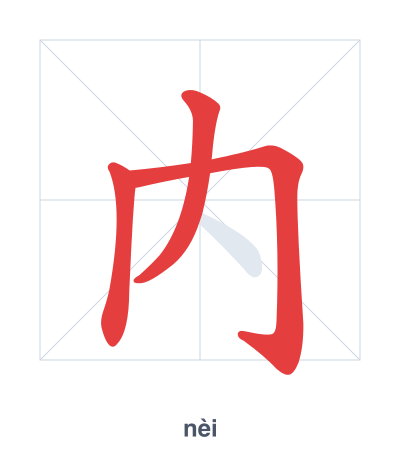
Open Hanzi Writer to see the animated stroke order and practice writing 内 with real-time feedback.
The character 内 (nèi) is written with 4 strokes. Follow the standard Chinese stroke order: top to bottom, left to right, outside before inside. The radical 入 is one of its key components.
Practice the correct stroke order with the Hanzi Writer app to see animated stroke-by-stroke guidance with real-time feedback.
内 means inside; inner; internal.
As an HSK Level 3 character, 内 is an intermediate-level character.
The character 内 originally depicted something entering an enclosure. Its ancient form combines 入 (to enter) with 冂 (a boundary or outline), showing the idea of going inside a defined space. This visual of entering within boundaries gave rise to its meaning of "inside" or "internal."
💡 Memory Tip: Picture a person (入) stepping into a square room (冂) to be inside.
室内非常暖和。
shì nèi fēi cháng nuǎn huo
It is very warm indoors.
这本书的内容很好。
zhè běn shū de nèi róng hěn hǎo
The content of this book is very good.
国内交通很方便。
guó nèi jiāo tōng hěn fāng biàn
Domestic transportation is very convenient.
Open Hanzi Writer to see the animated stroke order and practice writing 内 with real-time feedback.
✨ Animated stroke order · Handwriting recognition · HSK-graded practice · Free to use
Inside the radical 入 (enter), there is a 人 (person) shape, which suggests a person entering an enclosure. The outer box represents a boundary, and the inner part signifies something within that boundary. Together, they convey the idea of 'inside' or 'internal'.