葬 (zàng) means "to bury / funeral" in Chinese. It has 12 strokes with the radical 艹, and is HSK Level 7.
Rated 4.2/5 in difficulty (advanced).
Harder than 86% of HSK Level 7 characters.
Appears in 3+ common words including 葬礼 (zàng lǐ), 埋葬 (mái zàng), 火葬 (huǒ zàng).
Due to its 12 strokes, Hanzi Writer's error detection shows 葬 requires focused practice — most learners need 10+ attempts for consistent accuracy.
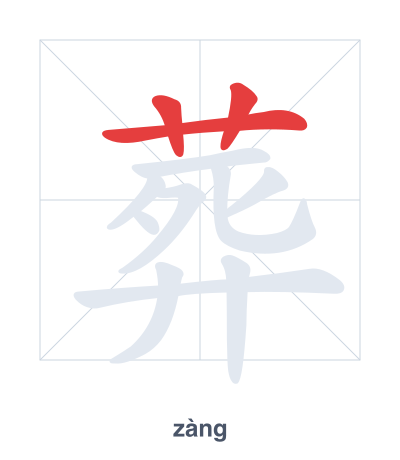
Open Hanzi Writer to see the animated stroke order and practice writing 葬 with real-time feedback.
The character 葬 (zàng) is written with 12 strokes. Follow the standard Chinese stroke order: top to bottom, left to right, outside before inside. The radical 艹 is one of its key components.
Practice the correct stroke order with the Hanzi Writer app to see animated stroke-by-stroke guidance with real-time feedback.
葬 means to bury / funeral.
As an HSK Level 7 character, 葬 is an intermediate-level character.
葬 combines grass (艹) on top, death (死) in the middle, and two hands (廾) at the bottom — picturing hands placing the deceased under a grassy covering, symbolizing burial.
💡 Memory Tip: Picture a dead body (死) being covered with grass (艹) as two hands (廾) pat down the dirt at a funeral.
葬礼在明天。
zàng lǐ zài míng tiān
The funeral is tomorrow.
埋葬在地下。
mái zàng zài dì xià
Buried underground.
他选择了火葬。
tā xuǎn zé le huǒ zàng
He chose cremation.
Open Hanzi Writer to see the animated stroke order and practice writing 葬 with real-time feedback.
✨ Animated stroke order · Handwriting recognition · HSK-graded practice · Free to use
葬 is made of three parts: the top radical 艹 (grass), the middle character 死 (death), and the bottom part 廾 (two hands). Together they suggest placing a dead body under grass with hands, symbolizing burial. The grass radical often indicates plants or covering, reinforcing the idea of covering the dead.