谀 (yú) means "To flatter; to fawn" in Chinese. It has 10 strokes with the radical 讠.
Rated 3.9/5 in difficulty (challenging).
Appears in 3+ common words including 谄谀 (chǎn yú), 阿谀 (ē yú), 谀辞 (yú cí).
Due to its 10 strokes, Hanzi Writer's error detection shows 谀 requires focused practice — most learners need 10+ attempts for consistent accuracy.
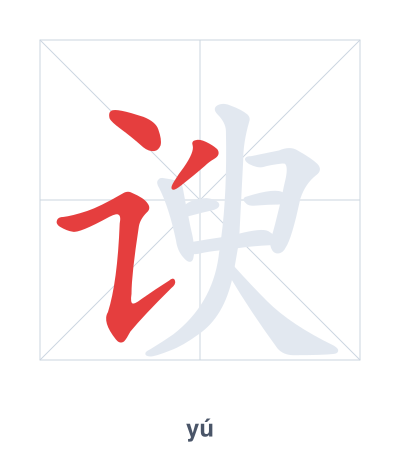
Open Hanzi Writer to see the animated stroke order and practice writing 谀 with real-time feedback.
The character 谀 (yú) is written with 10 strokes. Follow the standard Chinese stroke order: top to bottom, left to right, outside before inside. The radical 讠 is one of its key components.
Practice the correct stroke order with the Hanzi Writer app to see animated stroke-by-stroke guidance with real-time feedback.
谀 means To flatter; to fawn.
谀 is a phono-semantic compound. The left side, 讠 (speech), indicates that the character relates to words or speaking. The right side, 臾 (yú), serves as the phonetic component and originally depicted hands pulling or dragging something, suggesting the idea of 'pulling someone along' with flattering speech. Together, they convey the meaning of using words to fawn or flatter.
💡 Memory Tip: Imagine a flatterer speaking (讠) while literally pulling your leg (臾) with endless praise.
他不喜欢谄谀的人。
tā bù xǐ huān chǎn yú de rén
He doesn't like sycophants.
阿谀奉承没有用。
ē yú fèng chéng méi yǒu yòng
Flattery will get you nowhere.
满纸都是谀辞。
mǎn zhǐ dōu shì yú cí
The whole paper is full of flattery.
Open Hanzi Writer to see the animated stroke order and practice writing 谀 with real-time feedback.
✨ Animated stroke order · Handwriting recognition · HSK-graded practice · Free to use
The character 谀 is made of the radical 讠 (speech) on the left and the component 臾 (yú, a short moment) on the right. Since flattery involves speaking (讠) in a smooth, timely manner (臾 hints at a quick, fleeting act), the structure suggests words of praise spoken at just the right moment to gain favor.