瘿 (yǐng) means "goiter or gall" in Chinese. It has 16 strokes with the radical 疒.
Rated 4.2/5 in difficulty (advanced).
Appears in 3+ common words including 瘿瘤 (yǐng liú), 瘿木 (yǐng mù), 瘿气 (yǐng qì).
Due to its 16 strokes, Hanzi Writer's error detection shows 瘿 requires focused practice — most learners need 10+ attempts for consistent accuracy.
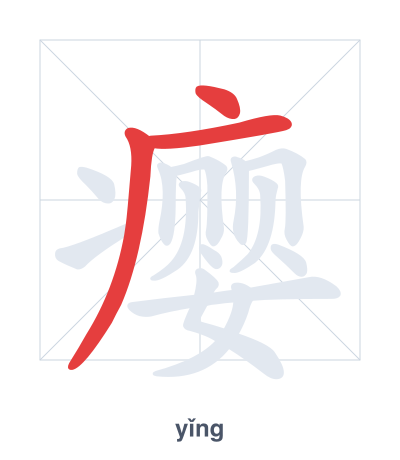
Open Hanzi Writer to see the animated stroke order and practice writing 瘿 with real-time feedback.
The character 瘿 (yǐng) is written with 16 strokes. Follow the standard Chinese stroke order: top to bottom, left to right, outside before inside. The radical 疒 is one of its key components.
Practice the correct stroke order with the Hanzi Writer app to see animated stroke-by-stroke guidance with real-time feedback.
瘿 means goiter or gall.
瘿 is a compound character combining the radical 疒 (illness) with 婴 (baby, phonetic yīng). The illness radical indicates a medical condition, while the baby component may suggest the goiter's rounded, head-like swelling on the neck.
💡 Memory Tip: Picture a baby (婴) with a large, lumpy goiter on its neck, sick (疒) and crying.
他的脖子上有个瘿瘤。
tā de bó zi shàng yǒu gè yǐng liú
He has a goiter on his neck.
这张桌子是瘿木做的。
zhè zhāng zhuō zi shì yǐng mù zuò de
This table is made of burl wood.
瘿气是一种甲状腺病。
yǐng qì shì yī zhǒng jiǎ zhuàng xiàn bìng
Goiter is a type of thyroid disease.
Open Hanzi Writer to see the animated stroke order and practice writing 瘿 with real-time feedback.
✨ Animated stroke order · Handwriting recognition · HSK-graded practice · Free to use
瘿 combines the radical 疒 (sickness) on the left with 婴 (yīng, baby) on the right. The radical shows that the word relates to a disease or medical condition, while 婴 gives the pronunciation and hints at a swollen shape like a baby's head. Together, they form a character for a goiter, a swelling on the neck caused by medical issues.