飘 (piāo) means "To float in the air; to flutter" in Chinese. It has 15 strokes with the radical 风, and is HSK Level 7.
Rated 4.2/5 in difficulty (advanced).
Harder than 98% of HSK Level 7 characters.
Appears in 3+ common words including 飘落 (piāo luò), 飘扬 (piāo yáng), 飘走 (piāo zǒu).
Due to its 15 strokes, Hanzi Writer's error detection shows 飘 requires focused practice — most learners need 10+ attempts for consistent accuracy.
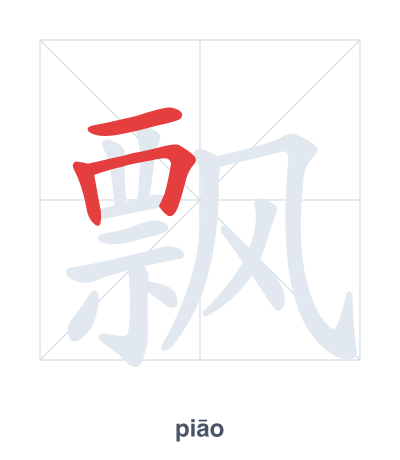
Open Hanzi Writer to see the animated stroke order and practice writing 飘 with real-time feedback.
The character 飘 (piāo) is written with 15 strokes. Follow the standard Chinese stroke order: top to bottom, left to right, outside before inside. The radical 风 is one of its key components.
Practice the correct stroke order with the Hanzi Writer app to see animated stroke-by-stroke guidance with real-time feedback.
飘 means To float in the air; to flutter.
As an HSK Level 7 character, 飘 is an intermediate-level character.
飘 combines the radical 风 (wind) with the phonetic component 票 (piào). The wind radical directly shows that the character relates to air movement, while 票 contributes the sound and also evokes the image of a light object, like a ticket or leaf, being carried upward. Together, they create the meaning of floating or fluttering in the air.
💡 Memory Tip: Imagine a ticket (票) caught in a gust of wind (风), fluttering and soaring high above the ground.
雪花从空中飘落。
xuě huā cóng kōng zhōng piāo luò
Snowflakes are falling from the sky.
国旗在风中飘扬。
guó qí zài fēng zhōng piāo yáng
The national flag is fluttering in the wind.
气球飘走了。
qì qiú piāo zǒu le
The balloon drifted away.
Open Hanzi Writer to see the animated stroke order and practice writing 飘 with real-time feedback.
✨ Animated stroke order · Handwriting recognition · HSK-graded practice · Free to use
飘 is made of 票 (piào, ticket) on top and 风 (fēng, wind) on the bottom. The radical 风 suggests wind is involved, while 票 gives the sound piāo. Together, they picture something light being carried by the wind — floating or fluttering.