议 (yì) means "To discuss or deliberate" in Chinese. It has 5 strokes with the radical 讠, and is HSK Level 3.
Rated 2.7/5 in difficulty (moderate).
Harder than 15% of HSK Level 3 characters.
Appears in 3+ common words including 会议 (huì yì), 建议 (jiàn yì), 议论 (yì lùn).
Hanzi Writer's stroke validation shows learners typically need 5-8 attempts to write 议 with correct proportion and order.
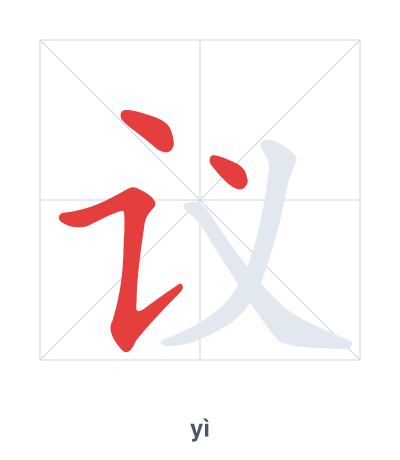
Open Hanzi Writer to see the animated stroke order and practice writing 议 with real-time feedback.
The character 议 (yì) is written with 5 strokes. Follow the standard Chinese stroke order: top to bottom, left to right, outside before inside. The radical 讠 is one of its key components.
Practice the correct stroke order with the Hanzi Writer app to see animated stroke-by-stroke guidance with real-time feedback.
议 means To discuss or deliberate.
As an HSK Level 3 character, 议 is an intermediate-level character.
The character 议 combines the radical 讠 (speech) on the left with 义 (yì, meaning 'justice' or 'righteousness') on the right. It originally depicted discussing matters of justice or proper conduct, so to deliberate is to speak about what is right.
💡 Memory Tip: Imagine two people sitting under a tree, one pointing to the speech radical (讠) and the other holding a 'justice' scale (义), debating what's fair—that's 议, to discuss.
会议室里正在进行重要的会议,请保持安静。
huì yì shì lǐ zhèng zài jìn xíng zhòng yào de huì yì , qǐng bǎo chí ān jìng 。
An important meeting is taking place in the conference room; please keep quiet.
我有一个好建议。
wǒ yǒu yí gè hǎo jiàn yì
I have a good suggestion.
大家都在小声地议论着刚才发生的奇怪事情。
dà jiā dōu zài xiǎo shēng dì yì lùn zhe gāng cái fā shēng de qí guài shì qíng 。
Everyone is whispering about the strange thing that just happened.
Open Hanzi Writer to see the animated stroke order and practice writing 议 with real-time feedback.
✨ Animated stroke order · Handwriting recognition · HSK-graded practice · Free to use
议 is made of the radical 讠 (speech) on the left and the phonetic component 义 on the right. 讠 indicates that the character relates to words or speaking, while 义 provides a hint for pronunciation (yì). Together, they form a character that means 'to discuss' or 'to deliberate' through speech.