倚 (yǐ) means "lean on / rely on" in Chinese. It has 10 strokes with the radical 亻, and is HSK Level 7.
Rated 3.9/5 in difficulty (challenging).
Harder than 33% of HSK Level 7 characters.
Appears in 3+ common words including 倚靠 (yǐ kào), 倚门 (yǐ mén), 倚重 (yǐ zhòng).
Due to its 10 strokes, Hanzi Writer's error detection shows 倚 requires focused practice — most learners need 10+ attempts for consistent accuracy.
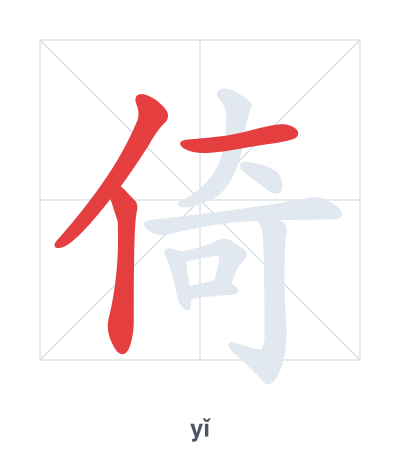
Open Hanzi Writer to see the animated stroke order and practice writing 倚 with real-time feedback.
The character 倚 (yǐ) is written with 10 strokes. Follow the standard Chinese stroke order: top to bottom, left to right, outside before inside. The radical 亻 is one of its key components.
Practice the correct stroke order with the Hanzi Writer app to see animated stroke-by-stroke guidance with real-time feedback.
倚 means lean on / rely on.
As an HSK Level 7 character, 倚 is an intermediate-level character.
This character combines the person radical (亻) with 奇 (qí, 'strange/odd'), which provides the phonetic clue. The meaning 'lean on' comes from the image of a person adopting an unusual sideways posture to rely on something for support.
💡 Memory Tip: Picture a person (亻) leaning at a strange angle (奇) against a crooked walking stick for support.
他倚靠在墙边。
tā yǐ kào zài qiáng biān
He leaned against the wall.
她倚门而望。
tā yǐ mén ér wàng
She leaned against the door and looked out.
他深受老板倚重。
tā shēn shòu lǎo bǎn yǐ zhòng
He is highly valued and relied upon by his boss.
Open Hanzi Writer to see the animated stroke order and practice writing 倚 with real-time feedback.
✨ Animated stroke order · Handwriting recognition · HSK-graded practice · Free to use
The left component is the radical 亻, which means 'person'. The right component is 奇, which provides the pronunciation (yǐ) and also suggests leaning or relying, as if a person is leaning on something unusual.