押 (yā) means "to mortgage or pawn" in Chinese. It has 8 strokes with the radical 扌, and is HSK Level 5.
Rated 3.7/5 in difficulty (challenging).
Harder than 35% of HSK Level 5 characters.
Appears in 3+ common words including 押金 (yā jīn), 扣押 (kòu yā), 押韵 (yā yùn).
Due to its 8 strokes, Hanzi Writer's error detection shows 押 requires focused practice — most learners need 10+ attempts for consistent accuracy.
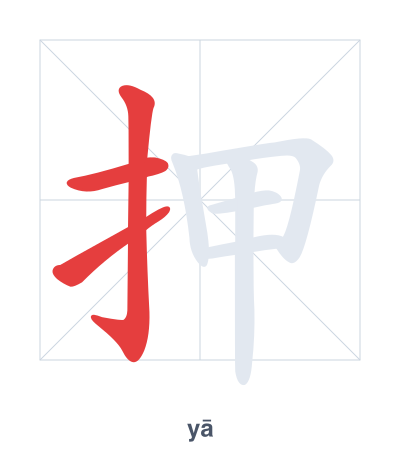
Open Hanzi Writer to see the animated stroke order and practice writing 押 with real-time feedback.
The character 押 (yā) is written with 8 strokes. Follow the standard Chinese stroke order: top to bottom, left to right, outside before inside. The radical 扌 is one of its key components.
Practice the correct stroke order with the Hanzi Writer app to see animated stroke-by-stroke guidance with real-time feedback.
押 means to mortgage or pawn.
As an HSK Level 5 character, 押 is an intermediate-level character.
押 is a compound character with the hand radical 扌 suggesting action, and 甲 (a pictograph of armor or a turtle shell) providing phonetic and semantic hints: pressing down on something hard, like a pawned item held under pressure. This aligns with the meaning of mortgaging or pawning, where an item is handed over as security.
💡 Memory Tip: Imagine your hand (扌) pressing a hard turtle shell (甲) onto a counter as you pawn it for cash.
租房需要交押金。
zū fáng xū yào jiāo yā jīn
Renting a house requires a security deposit.
护照被暂时扣押了。
hù zhào bèi zàn shí kòu yā le
The passport has been temporarily detained.
这首诗很押韵。
zhè shǒu shī hěn yā yùn
This poem rhymes well.
Open Hanzi Writer to see the animated stroke order and practice writing 押 with real-time feedback.
✨ Animated stroke order · Handwriting recognition · HSK-graded practice · Free to use
押 combines the hand radical 扌 on the left, indicating an action involving the hand, with 甲 (jiǎ, shell or armor) on the right, which gives the sound and hints at pressure or holding. Together, the hand pressing down on something suggests the idea of pawning or detaining an item.