膝 (xī) means "knee" in Chinese. It has 15 strokes with the radical 月, and is HSK Level 7.
Rated 4.2/5 in difficulty (advanced).
Harder than 84% of HSK Level 7 characters.
Appears in 3+ common words including 膝盖 (xī gài), 护膝 (hù xī), 膝下 (xī xià).
Due to its 15 strokes, Hanzi Writer's error detection shows 膝 requires focused practice — most learners need 10+ attempts for consistent accuracy.
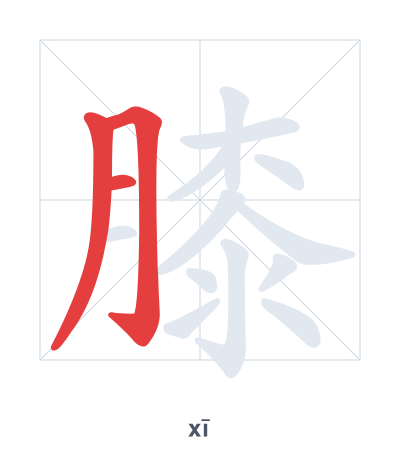
Open Hanzi Writer to see the animated stroke order and practice writing 膝 with real-time feedback.
The character 膝 (xī) is written with 15 strokes. Follow the standard Chinese stroke order: top to bottom, left to right, outside before inside. The radical 月 is one of its key components.
Practice the correct stroke order with the Hanzi Writer app to see animated stroke-by-stroke guidance with real-time feedback.
膝 means knee.
As an HSK Level 7 character, 膝 is an intermediate-level character.
膝 is a phono-semantic compound. The left side 月 (flesh radical) indicates it's a body part, while the right side 桼 (lacquer tree) originally served as a phonetic component (though the modern pronunciations have diverged). The ancient form of 桼 depicted a tree with dripping sap, but here it only contributes to sound.
💡 Memory Tip: Imagine your knee (月) is a lacquer tree (桼) that you must bend carefully to avoid cracking the sap.
我的膝盖很疼。
wǒ de xī gài hěn téng
My knee hurts a lot.
运动时要戴护膝。
yùn dòng shí yào dài hù xī
Wear knee pads when exercising.
他膝下有两个孩子。
tā xī xià yǒu liǎng gè hái zi
He has two children.
Open Hanzi Writer to see the animated stroke order and practice writing 膝 with real-time feedback.
✨ Animated stroke order · Handwriting recognition · HSK-graded practice · Free to use
The left part is 月, the flesh radical, showing that 膝 is a body part. The right part is 桼 (qī), which gives a hint to the pronunciation. Together, 月 and 桼 mean 'knee' because the knee is a part of the leg.