腠 (còu) means "interstices of the skin" in Chinese. It has 13 strokes with the radical 月.
Rated 4.2/5 in difficulty (advanced).
Appears in 3+ common words including 腠理 (còu lǐ), 腠理开 (còu lǐ kāi), 腠理闭 (còu lǐ bì).
Due to its 13 strokes, Hanzi Writer's error detection shows 腠 requires focused practice — most learners need 10+ attempts for consistent accuracy.
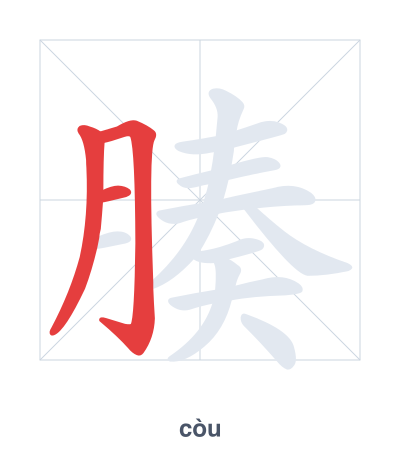
Open Hanzi Writer to see the animated stroke order and practice writing 腠 with real-time feedback.
The character 腠 (còu) is written with 13 strokes. Follow the standard Chinese stroke order: top to bottom, left to right, outside before inside. The radical 月 is one of its key components.
Practice the correct stroke order with the Hanzi Writer app to see animated stroke-by-stroke guidance with real-time feedback.
腠 means interstices of the skin.
腠 is a compound character with the radical 月 (flesh/body) indicating skin, and 奏 (to assemble or perform music) hinting at how fluids gather in the tiny spaces between tissues. The character evokes the idea of bodily interstices where substances like sweat or blood collect, much like notes assemble in a melody.
💡 Memory Tip: Picture a drummer (奏) whose skin has tiny gaps (月) between the muscles, like the spaces between drumbeats where sweat gathers.
他的腠理很紧。
tā de còu lǐ hěn jǐn
His skin texture is tight.
出汗时腠理开。
chū hàn shí còu lǐ kāi
Pores open when sweating.
受凉后腠理闭。
shòu liáng hòu còu lǐ bì
After catching a cold, the pores of the skin close.
Open Hanzi Writer to see the animated stroke order and practice writing 腠 with real-time feedback.
✨ Animated stroke order · Handwriting recognition · HSK-graded practice · Free to use
The left component is 月, the flesh radical, indicating the character relates to the body. The right component is 奏 (còu), which provides the pronunciation. Together, they create a character that refers to the small gaps or interstices in the skin.