霾 (mái) means "Haze or smog" in Chinese. It has 22 strokes with the radical 雨.
Rated 4.2/5 in difficulty (advanced).
Appears in 3+ common words including 雾霾 (wù mái), 霾天气 (mái tiān qì), 阴霾 (yīn mái).
Due to its 22 strokes, Hanzi Writer's error detection shows 霾 requires focused practice — most learners need 10+ attempts for consistent accuracy.
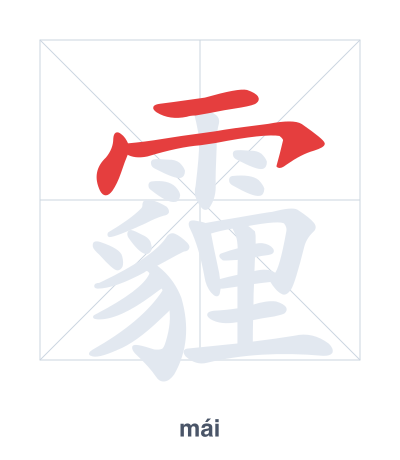
Open Hanzi Writer to see the animated stroke order and practice writing 霾 with real-time feedback.
The character 霾 (mái) is written with 22 strokes. Follow the standard Chinese stroke order: top to bottom, left to right, outside before inside. The radical 雨 is one of its key components.
Practice the correct stroke order with the Hanzi Writer app to see animated stroke-by-stroke guidance with real-time feedback.
霾 means Haze or smog.
霾 is a phono-semantic compound: the top radical 雨 (rain) indicates a weather phenomenon, while the bottom component 貍 (wild cat) provides the pronunciation mái. The character originally described a dusty haze or sandstorm mixed with weather, visualizing a blurry sky.
💡 Memory Tip: Imagine a wild cat (貍) sneezing in the rain (雨), creating a thick cloud of dusty smog all around.
今天的雾霾很严重。
jīn tiān de wù mái hěn yán zhòng
Today's smog is very serious.
霾天气要戴口罩。
mái tiān qì yào dài kǒu zhào
You should wear a mask in hazy weather.
散去心中的阴霾。
sàn qù xīn zhōng de yīn mái
Dispel the gloom in one's heart.
Open Hanzi Writer to see the animated stroke order and practice writing 霾 with real-time feedback.
✨ Animated stroke order · Handwriting recognition · HSK-graded practice · Free to use
霾 has the radical 雨 (rain) on top, showing it is related to weather or atmospheric phenomena. The bottom part 貍 (a wild cat) gives the pronunciation mái, but structurally it suggests haze or smog as a kind of dirty weather.