窝 (wō) means "nest / den / pit" in Chinese. It has 12 strokes with the radical 穴, and is HSK Level 7.
Rated 4.2/5 in difficulty (advanced).
Harder than 78% of HSK Level 7 characters.
Appears in 3+ common words including 鸟窝 (niǎo wō), 窝心 (wō xīn), 狗窝 (gǒu wō).
Due to its 12 strokes, Hanzi Writer's error detection shows 窝 requires focused practice — most learners need 10+ attempts for consistent accuracy.
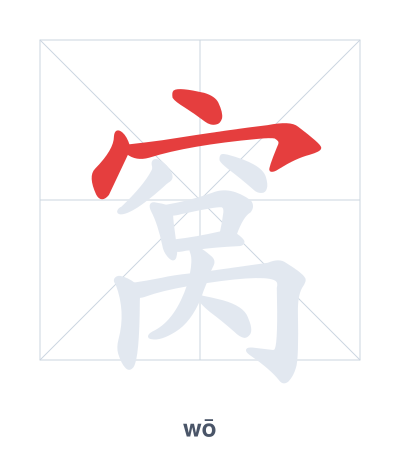
Open Hanzi Writer to see the animated stroke order and practice writing 窝 with real-time feedback.
The character 窝 (wō) is written with 12 strokes. Follow the standard Chinese stroke order: top to bottom, left to right, outside before inside. The radical 穴 is one of its key components.
Practice the correct stroke order with the Hanzi Writer app to see animated stroke-by-stroke guidance with real-time feedback.
窝 means nest / den / pit.
As an HSK Level 7 character, 窝 is an intermediate-level character.
窝 is a compound character with the radical 穴 (cave/hole) indicating its meaning of a hollow place, and the phonetic component 呙 (wō) providing the sound. Together, 穴 suggests a sheltered cavity, and the whole character denotes a nest, den, or pit where animals or objects are tucked away.
💡 Memory Tip: Picture a cave (穴) with a curled-up bird inside, its body forming the twisted shape of 呙, making a cozy nest.
树上有一个鸟窝。
shù shàng yǒu yí gè niǎo wō
There is a bird's nest in the tree.
这件事让他很窝心。
zhè jiàn shì ràng tā hěn wō xīn
This matter made him feel very frustrated.
小狗回到了狗窝。
xiǎo gǒu huí dào le gǒu wō
The puppy went back to its kennel.
Open Hanzi Writer to see the animated stroke order and practice writing 窝 with real-time feedback.
✨ Animated stroke order · Handwriting recognition · HSK-graded practice · Free to use
窝 combines the radical 穴 (cave/hole) on top with the component 呙 (wō) below. The radical 穴 gives the meaning of a hollow or cavity, which matches the character's sense of a nest or den. The bottom part mainly provides the pronunciation wō.