拖 (tuō) means "To drag / to mop / to delay" in Chinese. It has 8 strokes with the radical 扌, and is HSK Level 6.
Rated 3.7/5 in difficulty (challenging).
Harder than 28% of HSK Level 6 characters.
Appears in 3+ common words including 拖地 (tuō dì), 拖鞋 (tuō xié), 拖延 (tuō yán).
Due to its 8 strokes, Hanzi Writer's error detection shows 拖 requires focused practice — most learners need 10+ attempts for consistent accuracy.
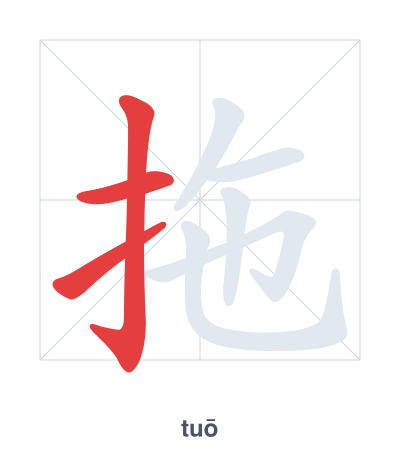
Open Hanzi Writer to see the animated stroke order and practice writing 拖 with real-time feedback.
The character 拖 (tuō) is written with 8 strokes. Follow the standard Chinese stroke order: top to bottom, left to right, outside before inside. The radical 扌 is one of its key components.
Practice the correct stroke order with the Hanzi Writer app to see animated stroke-by-stroke guidance with real-time feedback.
拖 means To drag / to mop / to delay.
As an HSK Level 6 character, 拖 is an intermediate-level character.
拖 combines the hand radical 扌 (action) with 它 ('it' or 'other'), suggesting using your hand to pull or haul something away. The component 它 also hints at the sound tuō, though its modern pronunciation is tā.
💡 Memory Tip: Picture a hand (扌) grabbing a snake (它) by the tail and dragging it across the floor.
我每天都拖地。
wǒ měi tiān dōu tuō dì
I mop the floor every day.
请换上拖鞋。
qǐng huàn shàng tuō xié
Please change into slippers.
不要再拖延时间了。
bú yào zài tuō yán shí jiān le
Stop procrastinating.
Open Hanzi Writer to see the animated stroke order and practice writing 拖 with real-time feedback.
✨ Animated stroke order · Handwriting recognition · HSK-graded practice · Free to use
拖 combines the hand radical 扌 on the left with 㐌 on the right. The hand radical suggests an action using the hand, while 㐌 (a phonetic component) gives the sound tuō. Together, the character conveys the idea of pulling or dragging something by hand.