颇 (pō) means "quite / rather / considerably" in Chinese. It has 11 strokes with the radical 页, and is HSK Level 7.
Rated 4.2/5 in difficulty (advanced).
Harder than 97% of HSK Level 7 characters.
Appears in 3+ common words including 颇为 (pō wèi), 颇多 (pō duō), 颇好 (pō hǎo).
Due to its 11 strokes, Hanzi Writer's error detection shows 颇 requires focused practice — most learners need 10+ attempts for consistent accuracy.
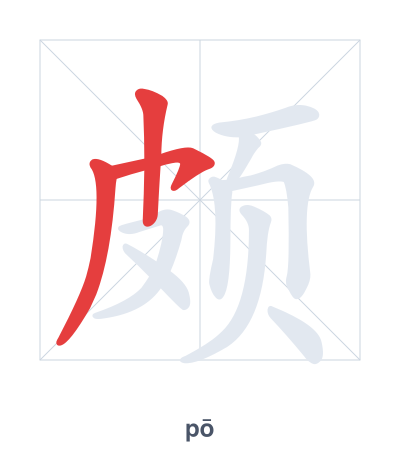
Open Hanzi Writer to see the animated stroke order and practice writing 颇 with real-time feedback.
The character 颇 (pō) is written with 11 strokes. Follow the standard Chinese stroke order: top to bottom, left to right, outside before inside. The radical 页 is one of its key components.
Practice the correct stroke order with the Hanzi Writer app to see animated stroke-by-stroke guidance with real-time feedback.
颇 means quite / rather / considerably.
As an HSK Level 7 character, 颇 is an intermediate-level character.
颇 combines 皮 (skin) and 页 (head). Originally it depicted a head tilted to one side, which metaphorically extended to mean 'rather' or 'quite'—implying a degree of deviation or partiality.
💡 Memory Tip: Picture a head (页) with a loose skin (皮) flap that tilts quite considerably to one side, emphasizing the meaning of 'rather'.
这个问题颇为复杂。
zhè ge wèn tí pō wèi fù zá
This problem is quite complex.
这里的游客颇多。
zhè lǐ de yóu kè pō duō
There are quite a lot of tourists here.
他的心情颇好。
tā de xīn qíng pō hǎo
He is in a rather good mood.
Open Hanzi Writer to see the animated stroke order and practice writing 颇 with real-time feedback.
✨ Animated stroke order · Handwriting recognition · HSK-graded practice · Free to use
The left component 皮 (pí) gives the character its pronunciation pō, while the right component 页 (yè) means 'head'. Originally, 颇 described a tilted head, which evolved to mean 'slanting' or 'partial', and today it is used as an adverb meaning 'quite' or 'rather'.