途 (tú) means "Way / Route" in Chinese. It has 10 strokes with the radical 辶, and is HSK Level 4.
Rated 4.2/5 in difficulty (advanced).
Harder than 95% of HSK Level 4 characters.
Appears in 3+ common words including 旅途 (lǚ tú), 途中 (tú zhōng), 用途 (yòng tú).
Due to its 10 strokes, Hanzi Writer's error detection shows 途 requires focused practice — most learners need 10+ attempts for consistent accuracy.
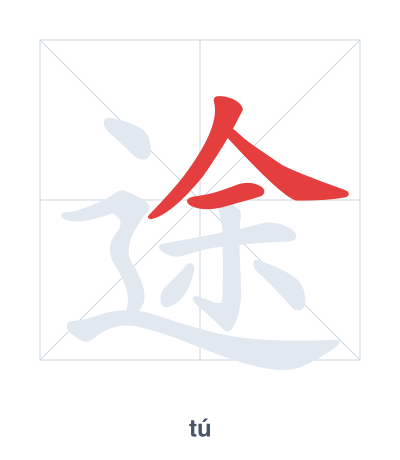
Open Hanzi Writer to see the animated stroke order and practice writing 途 with real-time feedback.
The character 途 (tú) is written with 10 strokes. Follow the standard Chinese stroke order: top to bottom, left to right, outside before inside. The radical 辶 is one of its key components.
Practice the correct stroke order with the Hanzi Writer app to see animated stroke-by-stroke guidance with real-time feedback.
途 means Way / Route.
As an HSK Level 4 character, 途 is an intermediate-level character.
途 is a phono-semantic compound. The radical 辶 (walking) indicates movement along a road, while the component 余 (yú) provides phonetic cues. Together they form the character meaning 'way' or 'route'.
💡 Memory Tip: Picture a traveler (余, like a person with arms out) striding along a winding path (辶) to follow the way.
祝你旅途愉快。
zhù nǐ lǚ tú yú kuài
Have a pleasant journey.
我在回家的途中。
wǒ zài huí jiā de tú zhōng
I am on my way home.
这个东西有很多用途。
zhè ge dōng xī yǒu hěn duō yòng tú
This thing has many uses.
Open Hanzi Writer to see the animated stroke order and practice writing 途 with real-time feedback.
✨ Animated stroke order · Handwriting recognition · HSK-graded practice · Free to use
途 is made of 余 (yú, meaning 'surplus' or 'I') on top and the radical 辶 (chuò, meaning 'walk' or 'move') at the bottom. The radical 辶 gives the meaning of a path or route, while 余 provides the pronunciation and hints at the idea of something that remains along the way. Together, they represent the concept of a 'way' or 'route' that one travels.