沮 (jǔ) means "depressed; to stop" in Chinese. It has 8 strokes with the radical 氵, and is HSK Level 7.
Rated 3.7/5 in difficulty (challenging).
Harder than 28% of HSK Level 7 characters.
Appears in 3+ common words including 沮丧 (jǔ sàng), 气沮 (qì jǔ), 沮止 (jǔ zhǐ).
Due to its 8 strokes, Hanzi Writer's error detection shows 沮 requires focused practice — most learners need 10+ attempts for consistent accuracy.
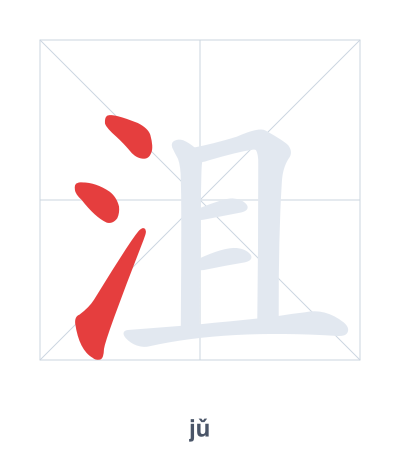
Open Hanzi Writer to see the animated stroke order and practice writing 沮 with real-time feedback.
The character 沮 (jǔ) is written with 8 strokes. Follow the standard Chinese stroke order: top to bottom, left to right, outside before inside. The radical 氵 is one of its key components.
Practice the correct stroke order with the Hanzi Writer app to see animated stroke-by-stroke guidance with real-time feedback.
沮 means depressed; to stop.
As an HSK Level 7 character, 沮 is an intermediate-level character.
沮 combines the water radical (氵) with the phonetic component 且 (jǔ). It originally described a marshy area where water stagnates, giving rise to meanings of stopping or hindering, and later extended to the feeling of depression from being blocked or stuck.
💡 Memory Tip: Picture water (氵) trapped behind a little table (且) that blocks its flow, making it stop and feel gloomy—沮.
别为这件事沮丧。
bié wèi zhè jiàn shì jǔ sàng
Don't be frustrated about this.
失败让他感到气沮。
shī bài ràng tā gǎn dào qì jǔ
Failure made him feel dejected.
警察沮止了这场争吵。
jǐng chá jǔ zhǐ le zhè chǎng zhēng chǎo
The police stopped the quarrel.
Open Hanzi Writer to see the animated stroke order and practice writing 沮 with real-time feedback.
✨ Animated stroke order · Handwriting recognition · HSK-graded practice · Free to use
沮 is made of the radical 氵 (water) on the left and the component 且 (qiě) on the right. The water radical suggests something flowing or stopping, and 且 adds a sense of obstruction, together suggesting "to stop" or a blocked flow. This blockage can also lead to feelings of being "depressed," as in 沮丧.