沭 (shù) means "Shu (name of a river)" in Chinese. It has 8 strokes with the radical 氵.
Rated 3.7/5 in difficulty (challenging).
Appears in 3+ common words including 沭河 (shù hé), 沭阳 (shù yáng), 临沭 (lín shù).
Due to its 8 strokes, Hanzi Writer's error detection shows 沭 requires focused practice — most learners need 10+ attempts for consistent accuracy.
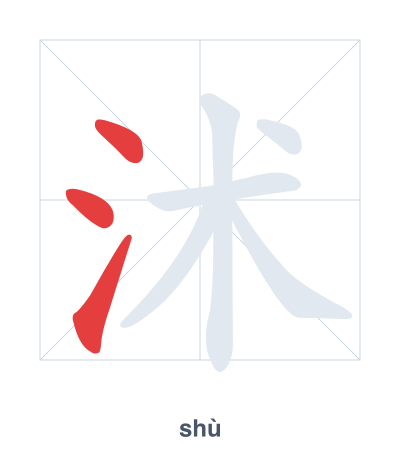
Open Hanzi Writer to see the animated stroke order and practice writing 沭 with real-time feedback.
The character 沭 (shù) is written with 8 strokes. Follow the standard Chinese stroke order: top to bottom, left to right, outside before inside. The radical 氵 is one of its key components.
Practice the correct stroke order with the Hanzi Writer app to see animated stroke-by-stroke guidance with real-time feedback.
沭 means Shu (name of a river).
沭 is a phono-semantic compound where the radical 氵 (water) indicates it's a river name, and 术 (shù) provides pronunciation. The character was created to name the Shu River in ancient China, literally meaning 'water of Shu.'
💡 Memory Tip: Picture water (氵) rushing past a tree (术) that marks the location of the Shu River.
沭河的水很清。
shù hé de shuǐ hěn qīng
The water of the Shu River is very clear.
他出生在沭阳。
tā chū shēng zài shù yáng
He was born in Shuyang.
临沭是一个好地方。
lín shù shì yí gè hǎo dì fāng
Linshu is a good place.
Open Hanzi Writer to see the animated stroke order and practice writing 沭 with real-time feedback.
✨ Animated stroke order · Handwriting recognition · HSK-graded practice · Free to use
沭 is composed of the water radical 氵 on the left and 术 (shù) on the right. The water radical indicates that the character is related to a river or water, and 术 provides the pronunciation. Together, they form the name of the Shu River.