捅 (tǒng) means "to poke; to stab; to disclose" in Chinese. It has 10 strokes with the radical 扌, and is HSK Level 7.
Rated 4.2/5 in difficulty (advanced).
Harder than 58% of HSK Level 7 characters.
Appears in 3+ common words including 捅破 (tǒng pò), 捅娄子 (tǒng lóu zi), 捅一下 (tǒng yī xià).
Due to its 10 strokes, Hanzi Writer's error detection shows 捅 requires focused practice — most learners need 10+ attempts for consistent accuracy.
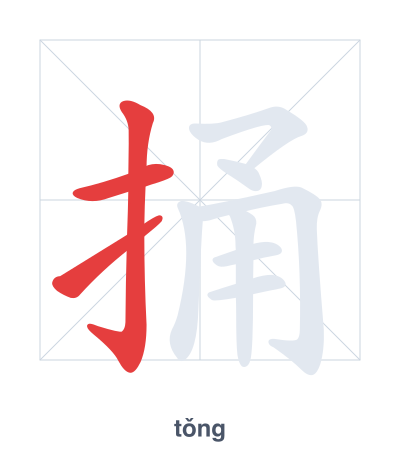
Open Hanzi Writer to see the animated stroke order and practice writing 捅 with real-time feedback.
The character 捅 (tǒng) is written with 10 strokes. Follow the standard Chinese stroke order: top to bottom, left to right, outside before inside. The radical 扌 is one of its key components.
Practice the correct stroke order with the Hanzi Writer app to see animated stroke-by-stroke guidance with real-time feedback.
捅 means to poke; to stab; to disclose.
As an HSK Level 7 character, 捅 is an intermediate-level character.
捅 is a phono-semantic compound. The radical 扌 (hand) indicates an action performed by the hand, while 甬 (yǒng, meaning a path or tunnel) contributes the sound and suggests the idea of something penetrating or going through a narrow passage—hence the hand poking or stabbing into something.
💡 Memory Tip: Picture a hand (扌) shoving a stick into a narrow tube (甬) to poke out a hidden secret.
别把这张纸捅破了。
bié bǎ zhè zhāng zhǐ tǒng pò le
Don't poke a hole in this paper.
由于他的疏忽,这次给项目组捅娄子了。。
yóu yú tā de shū hū , zhè cì gěi xiàng mù zǔ tǒng lóu zi le 。。
Due to his negligence, he caused trouble for the project team this time.
他用手指轻轻捅一下开关,灯就亮了。
tā yòng shǒu zhǐ qīng qīng tǒng yī xià kāi guān , dēng jiù liàng le 。
He gently poked the switch with his finger, and the light turned on.
Open Hanzi Writer to see the animated stroke order and practice writing 捅 with real-time feedback.
✨ Animated stroke order · Handwriting recognition · HSK-graded practice · Free to use
The character 捅 is made of the radical 扌 (hand) on the left and the phonetic component 甬 on the right. The hand radical suggests an action done with the hand, like poking or stabbing, while 甬 gives the sound tǒng. This combination clearly shows it is a hand-related action.