腆 (tiǎn) means "to stick out (one's chest or belly)" in Chinese. It has 12 strokes with the radical 月.
Rated 4.2/5 in difficulty (advanced).
Appears in 3+ common words including 腆着肚子 (tiǎn zhe dǔ zi), 腼腆 (miǎn tiǎn), 腆颜 (tiǎn yán).
Due to its 12 strokes, Hanzi Writer's error detection shows 腆 requires focused practice — most learners need 10+ attempts for consistent accuracy.
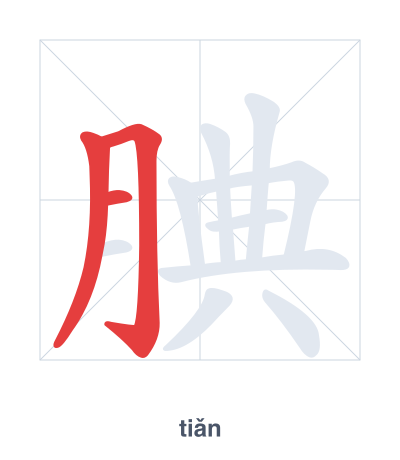
Open Hanzi Writer to see the animated stroke order and practice writing 腆 with real-time feedback.
The character 腆 (tiǎn) is written with 12 strokes. Follow the standard Chinese stroke order: top to bottom, left to right, outside before inside. The radical 月 is one of its key components.
Practice the correct stroke order with the Hanzi Writer app to see animated stroke-by-stroke guidance with real-time feedback.
腆 means to stick out (one's chest or belly).
腆 combines the flesh radical 月 (body) with 典 (diǎn, 'standard' or 'classic'), suggesting the body displayed as if presenting a model. The original meaning evolved to 'stick out' the chest or belly, like a proud posture showing off one's physique. The component 典 also provides phonetic cues to the pronunciation tiǎn.
💡 Memory Tip: Picture a person puffing out their chest and belly (月) while holding a classic book (典) like a proud scholar showing off.
他腆着肚子走路。
tā tiǎn zhe dǔ zi zǒu lù
He walks with his belly sticking out.
这个孩子很腼腆。
zhè ge hái zi hěn miǎn tiǎn
This child is very shy and bashful.
他腆颜向人求助。
tā tiǎn yán xiàng rén qiú zhù
He shamelessly asked for help.
Open Hanzi Writer to see the animated stroke order and practice writing 腆 with real-time feedback.
✨ Animated stroke order · Handwriting recognition · HSK-graded practice · Free to use
腆 is composed of the radical 月 (meat/flesh) on the left and 典 (diǎn, meaning 'standard' or 'classic') on the right. The left radical 月 indicates the character relates to the body, such as the belly or chest being stuck out. The right part 典 provides a phonetic clue, though the pronunciation differs slightly.