腼 (miǎn) means "shy / bashful" in Chinese. It has 13 strokes with the radical 月.
Rated 4.2/5 in difficulty (advanced).
Appears in 3+ common words including 腼腆 (miǎn tiǎn), 腼腆的人 (miǎn tiǎn de rén), 腼腆地 (miǎn tiǎn dì).
Due to its 13 strokes, Hanzi Writer's error detection shows 腼 requires focused practice — most learners need 10+ attempts for consistent accuracy.
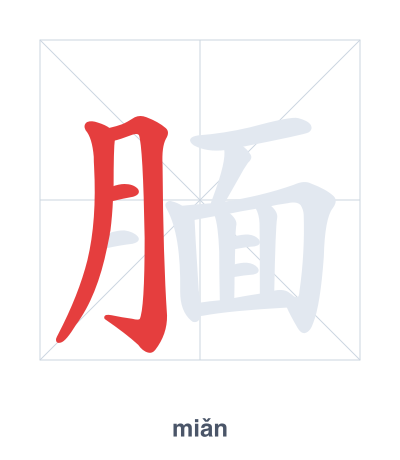
Open Hanzi Writer to see the animated stroke order and practice writing 腼 with real-time feedback.
The character 腼 (miǎn) is written with 13 strokes. Follow the standard Chinese stroke order: top to bottom, left to right, outside before inside. The radical 月 is one of its key components.
Practice the correct stroke order with the Hanzi Writer app to see animated stroke-by-stroke guidance with real-time feedback.
腼 means shy / bashful.
腼 is a phono-semantic compound, where 月 (flesh/body) suggests the physical aspect of shyness, and 面 (face) provides the pronunciation while also hinting at the face being the focal point of bashfulness. When someone feels shy, their face often flushes or they hide their face, linking the character's components to the emotion.
💡 Memory Tip: Imagine a shy person covering their face (面) with their hands, feeling the warm flesh (月) of their cheeks blush.
他性格很腼腆。
tā xìng gé hěn miǎn tiǎn
He is very shy.
她是个腼腆的人。
tā shì gè miǎn tiǎn de rén
She is a shy person.
他腼腆地笑了。
tā miǎn tiǎn dì xiào le
He gave a shy smile.
Open Hanzi Writer to see the animated stroke order and practice writing 腼 with real-time feedback.
✨ Animated stroke order · Handwriting recognition · HSK-graded practice · Free to use
腼 is made of the radical 月 (meat/flesh) on the left and 面 (miàn, face) on the right. The right side 面 hints at the face, so together they suggest a 'meat face' or facial expression — shyness often shows on one's face. This structure visually connects the character to bashfulness shown through facial reactions.