颜 (yán) means "Face; color" in Chinese. It has 15 strokes with the radical 页, and is HSK Level 2.
Rated 3.7/5 in difficulty (challenging).
Harder than 99% of HSK Level 2 characters.
Appears in 3+ common words including 颜色 (yán sè), 颜料 (yán liào), 容颜 (róng yán).
Due to its 15 strokes, Hanzi Writer's error detection shows 颜 requires focused practice — most learners need 10+ attempts for consistent accuracy.
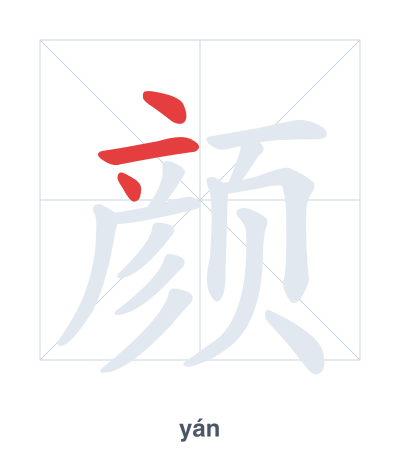
Open Hanzi Writer to see the animated stroke order and practice writing 颜 with real-time feedback.
The character 颜 (yán) is written with 15 strokes. Follow the standard Chinese stroke order: top to bottom, left to right, outside before inside. The radical 页 is one of its key components.
Practice the correct stroke order with the Hanzi Writer app to see animated stroke-by-stroke guidance with real-time feedback.
颜 means Face; color.
As an HSK Level 2 character, 颜 is among the first characters beginners learn.
颜 combines the radical 页 (head/face) with 彦 (a refined scholar). Originally referring to the forehead, it extended to mean the whole face and its complexion or color, as the face reflects one's character and emotions.
💡 Memory Tip: Picture a scholar (彦) whose face (页) changes color (颜) when he's embarrassed—his cheeks turn bright red.
我喜欢这个颜色。
wǒ xǐ huān zhè ge yán sè
I like this color.
老师买了新颜料。
lǎo shī mǎi le xīn yán liào
The teacher bought new paints.
她的容颜很美。
tā de róng yán hěn měi
Her face is very beautiful.
Open Hanzi Writer to see the animated stroke order and practice writing 颜 with real-time feedback.
✨ Animated stroke order · Handwriting recognition · HSK-graded practice · Free to use
颜 is made of two parts: the left side 彦 (yàn) and the right side 页 (yè). 页 originally means 'head' or 'page', and here it connects to the face, while 彦 gives the sound and also suggests 'appearance'. Together, they form the idea of 'facial color' or 'face'.