Hanzi Writer

How to Write 蹄 (tí) — Meaning “Hoof”

16 strokes Radical: 足

蹄 (tí) means "Hoof" in Chinese. It has 16 strokes with the radical 足.

Rated 4.2/5 in difficulty (advanced).

Appears in 3+ common words including 马蹄 (mǎ tí), 猪蹄 (zhū tí), 蹄子 (tí zi).

Due to its 16 strokes, Hanzi Writer's error detection shows 蹄 requires focused practice — most learners need 10+ attempts for consistent accuracy.
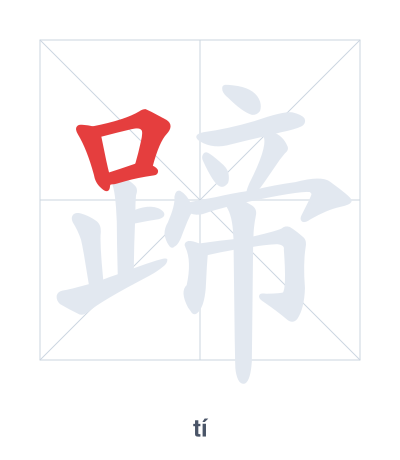
Stroke order practice for 蹄 - tí

Practice Writing 蹄 (tí)

Open Hanzi Writer to see the animated stroke order and practice writing 蹄 with real-time feedback.

The character (tí) is written with 16 strokes. Follow the standard Chinese stroke order: top to bottom, left to right, outside before inside. The radical is one of its key components.

Practice the correct stroke order with the Hanzi Writer app to see animated stroke-by-stroke guidance with real-time feedback.

means Hoof.

Character
Pinyintí (ti)
MeaningHoof
Strokes16
Radical
Difficulty4.2/5

蹄 is a phono-semantic compound. The radical 足 (foot) indicates it relates to feet or steps, while 帝 (dì, 'emperor') provides the pronunciation and originally also suggested the idea of 'standing firmly' — together, they depict an animal's hoof, the part that contacts the ground with authority.

💡 Memory Tip: Imagine the emperor (帝) stepping on the ground with his horse's foot (足), leaving a hoof-shaped crown imprint.

mǎ tí
Horse hoof
zhū tí
pork trotters
tí zi
Hoof

我听到了远处的马蹄声。

wǒ tīng dào le yuǎn chù de mǎ tí shēng

I heard the sound of horse hooves in the distance.

妈妈今天做了炖猪蹄。

mā mā jīn tiān zuò le dùn zhū tí

Mom made stewed pig's trotters today.

这只羊的蹄子受伤了。

zhè zhǐ yáng de tí zi shòu shāng le

This sheep's hoof is injured.

Character Pinyin Strokes Radical
(current) 16
tāng 15
14
xué 14
Stroke order practice for 蹄 - tí

Practice Writing 蹄 (tí)

Open Hanzi Writer to see the animated stroke order and practice writing 蹄 with real-time feedback.

✨ Animated stroke order · Handwriting recognition · HSK-graded practice · Free to use

Frequently Asked Questions about 蹄

The character 蹄 is made of two parts: the left side 足 (foot) and the right side 帝 (emperor). The 足 radical shows that the character relates to the foot or hoof of an animal. The right side 帝 gives a hint to the pronunciation, though it is said as tí, not dì.

Characters with Radical 足

Other 16-Stroke Characters