拴 (shuān) means "to tie; to fasten" in Chinese. It has 9 strokes with the radical 扌, and is HSK Level 7.
Rated 4/5 in difficulty (challenging).
Harder than 41% of HSK Level 7 characters.
Appears in 3+ common words including 拴住 (shuān zhù), 拴马 (shuān mǎ), 拴牢 (shuān láo).
Due to its 9 strokes, Hanzi Writer's error detection shows 拴 requires focused practice — most learners need 10+ attempts for consistent accuracy.
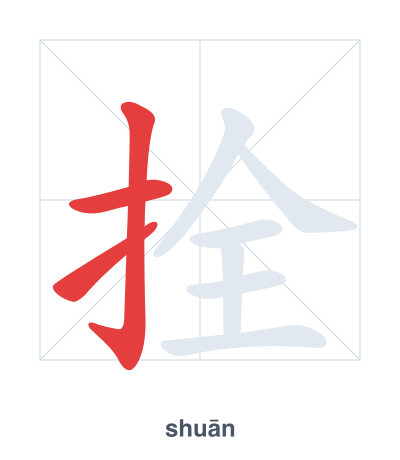
Open Hanzi Writer to see the animated stroke order and practice writing 拴 with real-time feedback.
The character 拴 (shuān) is written with 9 strokes. Follow the standard Chinese stroke order: top to bottom, left to right, outside before inside. The radical 扌 is one of its key components.
Practice the correct stroke order with the Hanzi Writer app to see animated stroke-by-stroke guidance with real-time feedback.
拴 means to tie; to fasten.
As an HSK Level 7 character, 拴 is an intermediate-level character.
The character 拴 combines the hand radical 扌 (indicating an action) with 全 (meaning 'complete' or 'whole'). Together, it suggests using your hand to make something secure and whole by tying or fastening it.
💡 Memory Tip: Picture your hand (扌) looping a rope around a whole (全) stack of boxes to fasten them tightly shut.
把狗拴住。
bǎ gǒu shuān zhù 。
Tie the dog up.
门口有拴马桩。
mén kǒu yǒu shuān mǎ zhuāng
There are hitching posts at the entrance.
绳子要拴牢。
shéng zi yào shuān láo
The rope must be tied securely.
Open Hanzi Writer to see the animated stroke order and practice writing 拴 with real-time feedback.
✨ Animated stroke order · Handwriting recognition · HSK-graded practice · Free to use
拴 combines the radical 扌 (hand) on the left, indicating the action is done with the hand, and the component 全 on the right. Although 全 means 'complete' or 'whole' in other contexts, here it contributes to the phonetic and overall idea of fully securing something. Together, they convey the meaning of using the hand to tie or fasten something tightly.