Hanzi Writer

How to Write 恕 (shù) — Meaning “to forgive”

shù HSK Level 7 10 strokes Radical: 心

恕 (shù) means "to forgive" in Chinese. It has 10 strokes with the radical 心, and is HSK Level 7.

Rated 4.2/5 in difficulty (advanced).

Harder than 55% of HSK Level 7 characters.

Appears in 3+ common words including 宽恕 (kuān shù), 饶恕 (ráo shù), 请恕 (qǐng shù).

Due to its 10 strokes, Hanzi Writer's error detection shows 恕 requires focused practice — most learners need 10+ attempts for consistent accuracy.
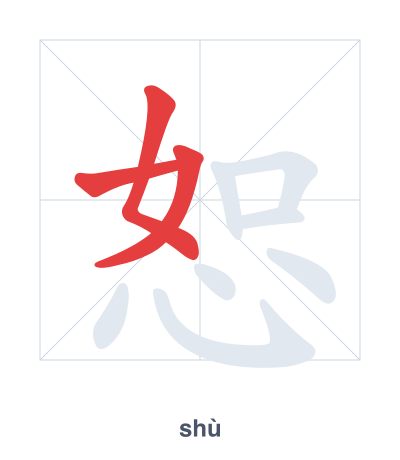
Stroke order practice for 恕 - shù

Practice Writing 恕 (shù)

Open Hanzi Writer to see the animated stroke order and practice writing 恕 with real-time feedback.

The character (shù) is written with 10 strokes. Follow the standard Chinese stroke order: top to bottom, left to right, outside before inside. The radical is one of its key components.

Practice the correct stroke order with the Hanzi Writer app to see animated stroke-by-stroke guidance with real-time feedback.

means to forgive.

As an HSK Level 7 character, is an intermediate-level character.

Character
Pinyinshù (shu)
Meaningto forgive
Strokes10
Radical
HSK Level7
Difficulty4.2/5

恕 (shù) combines the heart radical 心 (xīn) with 如 (rú, meaning 'like' or 'as'), suggesting treating others' mistakes as you would your own—a heart that understands and forgives. This compound implies empathy, where the heart makes things 'as if' they never happened.

💡 Memory Tip: Picture a heart (心) with a woman (女) opening her mouth (口) to say 'I forgive you'—the heart feels as (如) if the offense never occurred.

kuān shù
To forgive / Forgiveness
ráo shù
to forgive; to pardon
qǐng shù
Please forgive me.

请宽恕我的过错。

qǐng kuān shù wǒ de guò cuò

Please forgive my mistakes.

他无法饶恕自己。

tā wú fǎ ráo shù zì jǐ

He cannot forgive himself.

请恕我直言。

qǐng shù wǒ zhí yán

Please forgive my bluntness.

Character Pinyin Strokes Radical
(current) shù 10
tiǎn 8
mín 8
zhōng 8
Stroke order practice for 恕 - shù

Practice Writing 恕 (shù)

Open Hanzi Writer to see the animated stroke order and practice writing 恕 with real-time feedback.

✨ Animated stroke order · Handwriting recognition · HSK-graded practice · Free to use

Frequently Asked Questions about 恕

恕 is composed of two parts: the top part 如 (meaning 'like' or 'as') and the bottom part 心 (meaning 'heart'). The idea is that forgiveness comes from a heart that treats others as it would treat itself, so the structure combines 'as' and 'heart' to suggest 'a heart that acts as if for another'.

More HSK Level 7 Characters

Characters with Radical 心

Other 10-Stroke Characters