松 (sōng) means "pine; loose; relax" in Chinese. It has 8 strokes with the radical 木, and is HSK Level 4.
Rated 3.7/5 in difficulty (challenging).
Harder than 46% of HSK Level 4 characters.
Appears in 3+ common words including 放松 (fàng sōng), 松树 (sōng shù), 轻松 (qīng sōng).
Due to its 8 strokes, Hanzi Writer's error detection shows 松 requires focused practice — most learners need 10+ attempts for consistent accuracy.
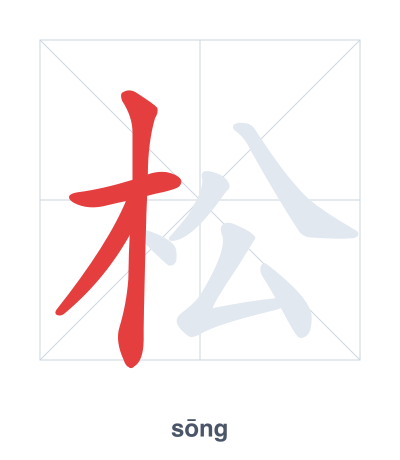
Open Hanzi Writer to see the animated stroke order and practice writing 松 with real-time feedback.
The character 松 (sōng) is written with 8 strokes. Follow the standard Chinese stroke order: top to bottom, left to right, outside before inside. The radical 木 is one of its key components.
Practice the correct stroke order with the Hanzi Writer app to see animated stroke-by-stroke guidance with real-time feedback.
松 means pine; loose; relax.
As an HSK Level 4 character, 松 is an intermediate-level character.
松 combines the tree radical 木 with 公 as a phonetic component (pronounced gōng, but shifted to sōng). Its original meaning is the pine tree, an evergreen conifer. The extended meanings 'loose' and 'relax' likely come from the pine's soft, flexible wood or the association of resting under a pine tree.
💡 Memory Tip: Picture a pine tree (木) in a public square (公) where people go to loosen up and relax.
请放松一下。
qǐng fàng sōng yī xià
Please relax a bit.
那是一棵松树。
nà shì yī kē sōng shù
That is a pine tree.
考试很轻松。
kǎo shì hěn qīng sōng
The exam was very easy.
Open Hanzi Writer to see the animated stroke order and practice writing 松 with real-time feedback.
✨ Animated stroke order · Handwriting recognition · HSK-graded practice · Free to use
The character 松 consists of the radical 木 (tree) on the left and 公 (gōng, public) on the right. The 木 component connects to the meaning 'pine tree', while 公 provides the pronunciation. When used for 'loose' or 'relax', the meaning comes from a separate borrowing and is not directly related to the tree.