攻 (gōng) means "to attack; to study" in Chinese. It has 7 strokes with the radical 攵, and is HSK Level 6.
Rated 3.5/5 in difficulty (challenging).
Harder than 20% of HSK Level 6 characters.
Appears in 3+ common words including 攻击 (gōng jī), 进攻 (jìn gōng), 攻读 (gōng dú).
Due to its 7 strokes, Hanzi Writer's error detection shows 攻 requires focused practice — most learners need 10+ attempts for consistent accuracy.
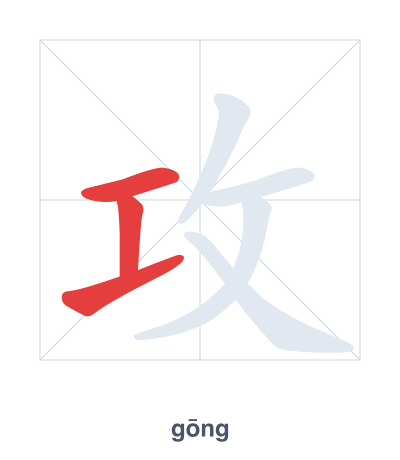
Open Hanzi Writer to see the animated stroke order and practice writing 攻 with real-time feedback.
The character 攻 (gōng) is written with 7 strokes. Follow the standard Chinese stroke order: top to bottom, left to right, outside before inside. The radical 攵 is one of its key components.
Practice the correct stroke order with the Hanzi Writer app to see animated stroke-by-stroke guidance with real-time feedback.
攻 means to attack; to study.
As an HSK Level 6 character, 攻 is an intermediate-level character.
攻 combines 工 (work) and 攵 (hand holding a stick to strike). The original meaning is to attack or strike at work, later extended to 'study' as in attacking a subject with effort.
💡 Memory Tip: Imagine a hand with a stick (攵) whacking a construction project (工) to attack it, or a student hitting the books to study.
不要攻击别人。
bú yào gōng jī bié rén
Don't attack others.
球队开始进攻。
qiú duì kāi shǐ jìn gōng
The team started to attack.
他在攻读博士。
tā zài gōng dú bó shì
He is studying for a doctorate.
Open Hanzi Writer to see the animated stroke order and practice writing 攻 with real-time feedback.
✨ Animated stroke order · Handwriting recognition · HSK-graded practice · Free to use
The left part 工 (gōng) suggests 'work' or 'labor,' and the right part 攵 (a form of 攴, meaning 'to strike' or 'to act') combines to create the idea of putting effort into an action. Together, they convey meanings like 'to attack' (striking at work) or 'to study' (working hard on learning).