阒 (qù) means "quiet; silent" in Chinese. It has 12 strokes with the radical 门.
Rated 4.2/5 in difficulty (advanced).
Appears in 3+ common words including 阒然 (qù rán), 阒寂 (qù jì), 阒无一人 (qù wú yī rén).
Due to its 12 strokes, Hanzi Writer's error detection shows 阒 requires focused practice — most learners need 10+ attempts for consistent accuracy.
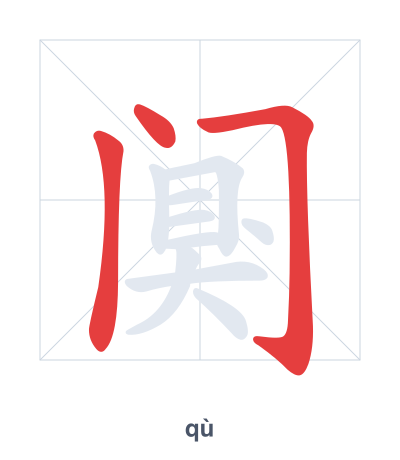
Open Hanzi Writer to see the animated stroke order and practice writing 阒 with real-time feedback.
The character 阒 (qù) is written with 12 strokes. Follow the standard Chinese stroke order: top to bottom, left to right, outside before inside. The radical 门 is one of its key components.
Practice the correct stroke order with the Hanzi Writer app to see animated stroke-by-stroke guidance with real-time feedback.
阒 means quiet; silent.
阒 is a phono-semantic compound combining the radical 门 (gate) with 臭 (stink) as a phonetic component. The original meaning was 'quiet within a gate,' later extended to general silence.
💡 Memory Tip: Imagine a gate (门) so quiet that the only sound is a dog (犬) sniffing (自) the still air.
四周阒然无声。
sì zhōu qù rán wú shēng
It was dead silent all around.
这里的环境很阒寂。
zhè lǐ de huán jìng hěn qù jì
The environment here is very quiet and still.
院子里阒无一人。
yuàn zi lǐ qù wú yī rén
The yard is completely silent and empty.
Open Hanzi Writer to see the animated stroke order and practice writing 阒 with real-time feedback.
✨ Animated stroke order · Handwriting recognition · HSK-graded practice · Free to use
The character 阒 has the radical 门 (gate) on the outside, which suggests a closed or enclosed space. Inside, it contains the component 犬 (dog) with a dot, evoking the image of a dog sitting silently behind a gate, representing quietness and stillness.